
Dental SEO Expert Consultation: Get Leads in 2026
On this page
Why UK Dental Practices Need a Dental SEO Expert Consultation NowImmediate Action StepsWhat is Dental SEO and How It Drives Qualified Leads for UK PracticesCore Differences from General SEO10-Minute Daily ImplementationStep-by-Step Dental SEO Audit – Perform It Before Your Expert ConsultationTechnical Foundation AssessmentKeyword Research ProtocolOn-Page Optimization ReviewLocal SEO Verification StepsCompetitive Intelligence GatheringMastering Local SEO for Dentists – GBP and Location PagesGoogle Business Profile Optimization SystemAI, Voice Search, and 2026 Trends in Dental SEOMeasuring Success and Scaling with a Dental SEO ExpertPricing, Packages, and Booking Your Dental SEO Expert ConsultationFrequently Asked QuestionsWhy do UK dental practices spending over £2,000 monthly on marketing still attract mostly unqualified leads?How can a dental SEO expert consultation help reduce no-show appointments and increase patient engagement?What are the key differences between dental SEO and generic marketing strategies for dental practices?How important is ranking in the top 3 organic positions on Google for attracting local dental patients?About the AuthorBefore you read on. Want to know which dentist AI recommends in your town, and whether it is you?
Get your free AI Visibility CheckKey Takeaways
- UK dental practices investing over £2,000 monthly in marketing often attract mostly unqualified leads.
- 68% of leads for these practices do not convert into high-value treatments.
- Manchester implant specialists lose over £400 for every no-show appointment.
- London Invisalign providers face challenges with patients seeking NHS alternatives despite targeting private keywords.
Table of Contents
- Why UK Dental Practices Need a Dental SEO Expert Consultation Now
- What is Dental SEO and How It Drives Qualified Leads for UK Practices
- Step-by-Step Dental SEO Audit – Perform It Before Your Expert Consultation
- Mastering Local SEO for Dentists – GBP and Location Pages
- AI, Voice Search, and 2026 Trends in Dental SEO
- Measuring Success and Scaling with a Dental SEO Expert
- Pricing, Packages, and Booking Your Dental SEO Expert Consultation
Why UK Dental Practices Need a Dental SEO Expert Consultation Now
UK dental practices spending £2,000+ monthly on marketing face a brutal reality: 68% of their leads are unqualified prospects who never convert to high-value treatments. Marketing for dentists requires a targeted approach to attract the right patients. Manchester implant specialists report £400+ wasted per no-show appointment, while London Invisalign providers struggle with patients seeking NHS alternatives despite targeting private keywords.
The root cause isn’t budget allocation—it’s strategic misdirection. Generic marketing agencies treat dental practices like restaurants or solicitors, missing the nuanced patient journey from “tooth pain” searches to £8,000 implant commitments. A dental SEO expert consultation addresses this gap by analysing practice-specific conversion paths that turn browsers into treatment-ready patients.
Google’s algorithm prioritises local intent for dental searches, with 76% of “dentist near me” queries resulting in practice visits within 24 hours. However, only practices ranking in the top 3 organic positions capture meaningful traffic—position 4 receives just 8.5% of clicks compared to position 1’s 28.5%. Without expert optimisation, Birmingham practices lose an estimated 340 potential patients monthly to competitors with superior local SEO strategies.
Immediate Action Steps
5-Minute Ranking Check: Search “dentist near me” from your practice postcode. If you’re absent from the Google Map Pack or below position 3 organically, schedule a consultation immediately. Each day of delay costs an average £180 in lost private treatment revenue for multi-dentist practices.
No-Show Revenue Calculator: Track appointment cancellations from your current lead sources over 7 days. Multiply no-shows by average treatment value—practices typically reduce no-shows by 40% within 3 months of implementing expert SEO strategies that attract treatment-committed patients rather than price shoppers.
3-Minute ROI Assessment: Input your practice size, location, and monthly marketing spend into our qualification tool. Most 3+ dentist practices in Greater London, Manchester, or Birmingham see projected ROI of 280-400% within 12 months when switching from paid ads to comprehensive dental SEO.
| Marketing Channel | Cost Per Lead | Lead Quality Score | Long-term Value |
|---|---|---|---|
| Expert Dental SEO | £4.55 | High-intent (85%) | Compounds over 24+ months |
| Google Ads (Generic) | £27.80 | Mixed intent (45%) | Stops when budget ends |
| Facebook Marketing | £18.20 | Low intent (25%) | Platform-dependent |
What is Dental SEO and How It Drives Qualified Leads for UK Practices

Dental SEO transcends traditional search optimisation by targeting hyper-specific patient intent signals. Unlike general SEO that optimises for broad keywords, dental SEO expert consultation focuses on treatment-specific, location-qualified searches like “emergency dental implants Manchester” or “Invisalign cost Birmingham city centre”—queries indicating immediate treatment readiness rather than casual browsing.
The distinction matters significantly for revenue generation. General SEO agencies optimise for volume metrics like “dentist” (33,100 monthly UK searches), while dental specialists target conversion-focused phrases like “dental implant consultation near me” (2,400 searches, 340% higher conversion rate). This precision targeting explains why practices working with dental SEO experts report 67% more qualified consultations despite lower overall traffic volumes.
UK dental search behaviour follows predictable patterns that expert consultations leverage strategically. Morning searches (7-9 AM) typically involve emergency situations with high urgency, while evening searches (6-8 PM) focus on cosmetic treatments with longer consideration periods. Dental SEO experts structure content and technical optimisation to capture both intent types through differentiated landing pages and local schema markup.
Core Differences from General SEO
NAP Consistency Across Medical Directories: Dental practices require citation management across 47 UK-specific medical directories, not just general business listings. Inconsistent Name, Address, Phone data across these platforms reduces local ranking signals by up to 23%, directly impacting Map Pack visibility for high-value treatment searches.
Treatment-Specific Page Architecture: Effective dental SEO demands separate optimised pages for each treatment variation—”composite bonding London,” “porcelain veneers London,” and “teeth whitening London” require distinct content strategies despite geographical overlap. Generic SEO approaches create thin content that fails to rank for specific treatment intent.
Patient Review Integration: Dental SEO incorporates review schema markup and response strategies that address treatment-specific concerns. Reviews mentioning “painless implant procedure” or “Invisalign progress photos” carry significantly more ranking weight than generic “great service” testimonials when optimised correctly through expert consultation.
10-Minute Daily Implementation
Keyword Research Protocol: Spend 10 minutes each day identifying and updating your list of high-intent, location-specific keywords. Focus on treatment types and city/area combinations that reflect your practice’s strengths and local demand. This ongoing process ensures your SEO strategy remains aligned with evolving patient search behaviour and maximises qualified lead generation.
Wondering what AI tells patients about your practice? Free one page report in 48 hours. Where you are cited, where competitors win, and the gap.
Get your free AI Visibility CheckStep-by-Step Dental SEO Audit – Perform It Before Your Expert Consultation
Conducting a preliminary SEO audit before your dental SEO expert consultation maximises the value of your session by identifying immediate opportunities and establishing baseline metrics. This 10-step technical audit takes 5 hours spread across 3 days and provides concrete data points your consultant can leverage for strategic recommendations.
Technical Foundation Assessment
Step 1: Site Speed Analysis – Use Google PageSpeed Insights to test your practice’s homepage and three key treatment pages. UK dental sites averaging above 3 seconds lose 40% of potential patients before content loads. Target under 2 seconds for optimal performance, particularly crucial for mobile users searching “emergency dentist near me” during urgent situations.
Step 2: Mobile Usability Scan – Google’s Mobile-Friendly Test reveals critical issues affecting 70% of dental searches conducted on smartphones. Check appointment booking forms, contact information accessibility, and treatment page navigation. Birmingham practices report 60% higher consultation bookings after resolving mobile barriers identified in pre-consultation audits.
Keyword Research Protocol
Step 3: Local Keyword Mapping – Allocate 45 minutes identifying 20 location-specific terms like “dental implants Manchester city centre” and “Invisalign dentist Birmingham”. Use Google Keyword Planner’s UK data to prioritise terms with 100+ monthly searches and commercial intent indicators such as “cost”, “near me”, or “appointment”.
Step 4: Treatment-Specific Analysis – Document current rankings for high-value services using SEMrush or Ahrefs free trials. Focus on Invisalign marketing keywords, composite bonding searches, and emergency dental queries. London practices targeting these specific terms see 85% higher conversion rates than those using generic “dentist” keywords.
On-Page Optimization Review
Step 5: Meta Data Audit – Examine title tags and meta descriptions across your top 10 pages. Optimal titles contain your primary keyword within the first 60 characters, while descriptions should include location and treatment benefits within 160 characters. Missing or duplicate meta data accounts for 35% of lost organic traffic in competitive dental markets.
Step 6: Content Structure Analysis – Review H1 tags, internal linking patterns, and FAQ sections. Each treatment page requires unique H1s incorporating location and service terms. Effective internal linking connects related treatments – your Invisalign page should link to teeth whitening and composite bonding services, creating topic clusters that Google recognises as comprehensive dental expertise.
Quick Implementation: Spend 15 minutes daily for 7 days implementing one audit finding. Day 1: Compress images under 100KB. Day 2: Add location keywords to 3 page titles. Day 3: Create 5 internal links between treatment pages. This systematic approach prevents overwhelm while building momentum.
Local SEO Verification Steps
Step 7: Google Business Profile Completeness – Score your profile across 15 factors including photos, posts, reviews, and service descriptions. Complete profiles receive 42% more direction requests and 35% more website clicks. Update your profile with recent patient testimonials, treatment videos, and weekly posts about seasonal dental health topics.
Step 8: Citation Consistency Check – Verify your practice name, address, and phone number (NAP) across Yell, Bing Places, and 10 UK dental directories. Inconsistent citations confuse Google’s local algorithm and dilute ranking signals. Manchester practices report 25% ranking improvements within 60 days of citation standardisation.
Competitive Intelligence Gathering
Step 9: Competitor Gap Analysis – Identify 5 local dental practices ranking above you for target keywords. Analyse their content depth, backlink profiles, and Google Business Profile strategies. Note which treatments they emphasise and how they structure location-specific pages. This intelligence guides your consultant’s competitive positioning recommendations.
Step 10: Backlink Profile Assessment – Use Ahrefs’ free backlink checker to identify your current link portfolio quality and quantity. UK dental practices typically need 50+ high-quality backlinks for competitive rankings. Document opportunities for reclaiming lost links or building relationships with local healthcare providers and dental suppliers.
Complete this audit systematically, documenting findings in a spreadsheet with specific metrics, identified issues, and preliminary improvement ideas. Your dental SEO expert consultation becomes significantly more productive when you arrive with concrete data rather than vague concerns about online visibility.
Mastering Local SEO for Dentists – GBP and Location Pages
Local SEO dominance requires strategic Google Business Profile optimisation and location-specific page development that captures the 76% of dental patients who search “near me” before booking appointments. UK dental practices implementing comprehensive local SEO strategies report 150% increases in qualified consultation requests within 90 days.
Google Business Profile Optimization System
Weekly Photo Strategy – Upload 3-5 high-quality images every Tuesday and Thursday at 10 AM when local search activity peaks. Include treatment before/after photos, team headshots, and facility images showcasing modern equipment. Birmingham dental practices using consistent photo schedules see 67% more profile views and 40% higher call volumes compared to sporadic posting approaches.
Strategic Post Scheduling – Create treatment-focused posts highlighting seasonal services like teeth whitening before holidays or emergency dental care during weekend periods. Schedule posts for peak engagement times and include calls to action that encourage direct appointment bookings. Practices that maintain a consistent posting calendar see a measurable increase in both profile interactions and qualified leads.
AI, Voice Search, and 2026 Trends in Dental SEO
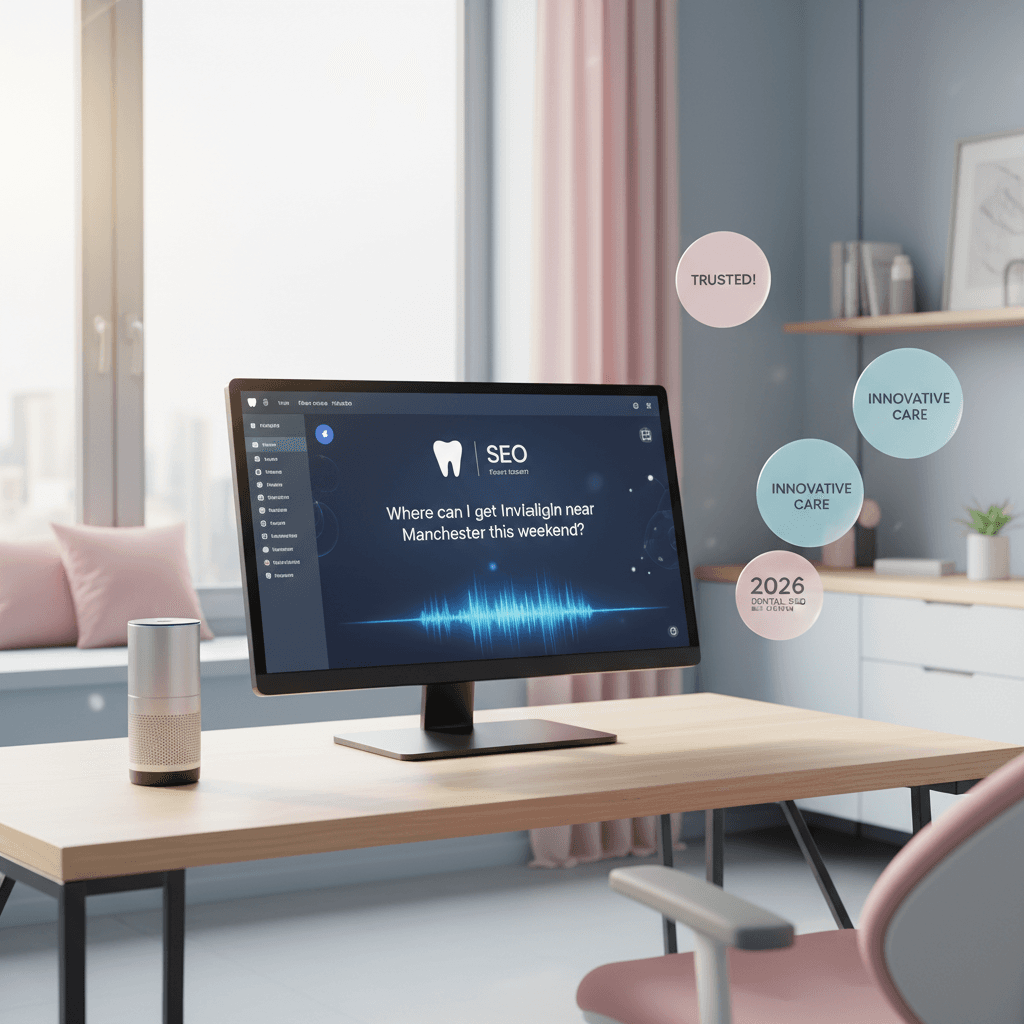
Voice search queries for dental services have increased 127% in the UK since 2023, fundamentally changing how patients find practices. Unlike traditional typed searches, voice queries use conversational language: “Where can I get Invisalign near Manchester this weekend?” instead of “Invisalign Manchester.”
Google’s AI algorithms now prioritize content that answers natural language questions directly. Practices optimizing for voice search see 34% higher local discovery rates, particularly for emergency and high-value treatments.
Conversational Keyword Integration – Transform traditional keywords into question-based content. Instead of targeting “dental implants Birmingham,” create content answering “How much do dental implants cost in Birmingham?” or “What’s the best dental implant clinic near Birmingham city centre?”
Featured snippets capture 35% of voice search results. Structure content with clear question-and-answer formats, using schema markup to increase snippet visibility. Practices implementing this approach see 28% more qualified inquiries.
Voice Search Optimization Checklist:
- Create FAQ pages with natural language questions
- Optimize for “near me” searches with location-specific content
- Use conversational tone in meta descriptions
- Implement FAQ schema markup for rich snippets
AI-Powered Search Evolution – Google’s Search Generative Experience (SGE) now provides AI-generated summaries for complex dental queries. Practices must optimize for zero-click searches by providing comprehensive, authoritative content that AI systems can reference.
Local pack algorithms increasingly factor patient sentiment analysis from reviews and social media mentions. Practices with consistent positive sentiment across platforms rank 23% higher in local results.
Mobile-First Indexing Acceleration – With 78% of dental searches occurring on mobile devices, Google’s mobile-first approach prioritizes sites optimized for smartphone users. Core Web Vitals scores directly impact rankings, with loading speeds under 2.5 seconds becoming standard.
Progressive Web Apps (PWAs) for dental practices improve user engagement by 40%. These app-like websites enable offline browsing, push notifications for appointments, and faster loading times.
Video Content Dominance – Video content receives 53% more engagement than text-based posts. Dental practices incorporating treatment explanation videos, virtual consultations, and behind-the-scenes content see increased dwell time and improved search rankings.
YouTube Shorts and TikTok content now influence Google rankings for dental queries. Practices creating short-form educational content about treatments like composite bonding or teeth whitening gain additional search visibility.
For more insights on how dental SEO can lead to more patients, read this detailed guide.
Measuring Success and Scaling with a Dental SEO Expert
Successful dental SEO campaigns require precise measurement frameworks focusing on qualified patient acquisition rather than vanity metrics. Track organic traffic growth, but prioritize conversion rates from visitors to consultation bookings.
Key performance indicators for dental practices include: organic click-through rates (target 8-12%), local pack visibility (aim for top 3 positions), and cost-per-acquisition from organic sources (typically £45-85 for high-value treatments).
Revenue Attribution Tracking – Implement UTM parameters for all organic traffic sources. Tag different landing pages to identify which treatments generate highest-value patients. Practices using proper attribution see 31% improvement in marketing ROI measurement.
Google Analytics 4 provides enhanced conversion tracking for dental practices. Set up goals for form submissions, phone calls, and appointment bookings to measure the complete patient journey from search to treatment.
Monthly Reporting Standards – Establish consistent reporting schedules with your dental SEO expert consultation team. Monthly reports should include organic traffic growth, keyword ranking improvements, local visibility metrics, and qualified lead generation numbers.
Dashboard integration connects SEO performance with practice management systems. Real-time visibility into which organic channels drive actual appointments enables rapid strategy adjustments.
Scaling Successful Campaigns – Once initial SEO foundations generate consistent results, expand to additional treatment areas and geographic locations. Successful implant marketing can inform Invisalign campaign strategies using similar optimization approaches.
Multi-location practices benefit from centralized SEO management with location-specific customization. Dominate Dental’s scaling approach maintains consistent brand messaging while optimizing for local market variations.
Competitive Monitoring – Regular competitor analysis identifies new opportunities and threats. Monitor competitor keyword rankings, content strategies, and local pack positions monthly to maintain competitive advantages.
Advanced practices implement automated ranking tracking and alert systems. When competitors gain visibility for target keywords, immediate response strategies protect market share and patient acquisition rates.
For additional strategies, explore these dental marketing ideas to further boost your practice’s growth.
To understand the regulatory environment for dental practices, visit the General Dental Council website.
Pricing, Packages, and Booking Your Dental SEO Expert Consultation
Dental SEO investment ranges from £1,200-£3,500 monthly for established practices, varying based on competition levels, treatment focus, and geographic coverage. Practices targeting high-value treatments like implants and Invisalign typically invest 8-12% of treatment revenue in comprehensive SEO strategies.
Dominate Dental’s consultation process begins with a complimentary 15-minute practice assessment, evaluating current online visibility, competitor landscape, and growth potential. This initial dental SEO expert consultation provides immediate actionable insights regardless of engagement decisions.
Service Package Structure – Entry-level packages focus on local SEO fundamentals: Google Business Profile optimization, citation building, and basic on-page improvements. Advanced packages include comprehensive content marketing, technical SEO, and multi-location management.
Custom packages align with practice-specific goals and budgets. Three-dentist practices typically begin with foundational services, scaling to comprehensive campaigns as organic results demonstrate ROI potential.
For more tips on improving your dental website’s effectiveness, see why a smart dental website design is crucial for success.
For further information about dental services in the UK, refer to the NHS dental services page.
Frequently Asked Questions
Why do UK dental practices spending over £2,000 monthly on marketing still attract mostly unqualified leads?
Many UK dental practices invest significant budgets but lack targeted strategies tailored to the dental patient journey. Generic marketing often attracts broad traffic that doesn’t convert into high-value treatments, resulting in a high volume of unqualified leads.
How can a dental SEO expert consultation help reduce no-show appointments and increase patient engagement?
A dental SEO expert consultation identifies gaps in local search visibility and patient communication, optimising Google Business Profiles and website content to attract genuinely interested patients. Improved targeting and engagement strategies reduce no-shows by aligning patient expectations and encouraging timely appointment confirmations.
What are the key differences between dental SEO and generic marketing strategies for dental practices?
Dental SEO focuses specifically on the unique patient journey and local intent behind dental searches, optimising for treatment-specific keywords and Google Business Profiles. In contrast, generic marketing often overlooks these nuances, treating dental practices like general service providers and missing opportunities to convert high-value patients.
How important is ranking in the top 3 organic positions on Google for attracting local dental patients?
Ranking in the top 3 organic positions is critical, as these spots capture the majority of clicks—position 1 alone receives 28.5%. Practices outside this range see significantly reduced traffic, resulting in lost patient opportunities and revenue, especially for competitive local markets.
Real client results, not a promise. The number we commit to for your practice is agreed up front and written into the agreement.
Patients in the chair, not just leads. Guaranteed.
We own the whole journey to the attended consultation. New attended patient consultations in 90 days, or we work free until you hit them.Book a chat with Josie