Digital Impression Dentistry 2026: The Ultimate UK Guide for Dentists
On this page
What Is Digital Impression Dentistry?Digital Impression Dentistry vs. Traditional ImpressionsHow Digital Impressions Work, From Patient to LabAppointment PreparationScanning Workflow StepsFile Transfer and IntegrationApplications in Modern UK Dental PracticeInvisalign and Clear Aligner TherapyDental Implant PlanningComplex Restorative CasesChoosing Your Digital Impression System, Brands, Features, and ROI Analysis (2025 UK Edition)Enhancing Patient Experience & Practice Efficiency Through Digital ImpressionsCommon Problems in Digital Impression Dentistry, and How to Solve ThemData Management, Security & Digital Compliance in UK Dental PracticeDigital Security Protocols and Best PracticesFuture of Digital Impression Dentistry, Emerging TechnologiesWhy Digital Impression Dentistry Transforms UK Dental PracticesFrequently Asked QuestionsWhat are the main advantages of digital impression dentistry compared to traditional impression methods?How does digital impression technology improve patient comfort and reduce appointment cancellations?What factors should UK dental practices consider when choosing a digital impression system in 2025?How do digital impressions enhance treatment acceptance rates and overall practice efficiency?About the AuthorBefore you read on. Want to know which dentist AI recommends in your town, and whether it is you?
Get your free AI Visibility CheckKey Takeaways
- Digital impression dentistry is a major advancement in dental diagnostics, comparable to the impact of X-ray technology.
- UK dental practices using digital scanning experience a 23% increase in treatment acceptance rates.
- Digital impression methods result in 40% fewer appointment cancellations compared to traditional techniques.
Table of Contents
- What Is Digital Impression Dentistry?
- Digital Impression Dentistry vs. Traditional Impressions
- How Digital Impressions Work, From Patient to Lab
- Applications in Modern UK Dental Practice
- Choosing Your Digital Impression System, Brands, Features, and ROI Analysis (2025 UK Edition)
- Enhancing Patient Experience & Practice Efficiency Through Digital Impressions
- Common Problems in Digital Impression Dentistry, and How to Solve Them
- Data Management, Security & Digital Compliance in UK Dental Practice
- Digital Security Protocols and Best Practices
- Future of Digital Impression Dentistry, Emerging Technologies
- Why Digital Impression Dentistry Transforms UK Dental Practices
Digital Impression Dentistry: Complete UK Guide
Digital impression dentistry represents the most significant advancement in dental diagnostics since X-ray technology. UK practices adopting digital scanning report 23% higher treatment acceptance rates and 40% fewer appointment cancellations compared to traditional impression methods.
This comprehensive guide examines every aspect of digital impression technology, from clinical applications to ROI analysis, helping UK dental practices make informed investment decisions for 2025 and beyond. For practices seeking to maximise their digital investment, a well-crafted dental marketing plan is essential to attract and convert high-value patients.
To further enhance your digital presence and patient acquisition, consider the benefits of SEO for dentists as part of your overall strategy.
What Is Digital Impression Dentistry?
Digital impression dentistry uses advanced intraoral scanning technology to capture highly accurate 3D images of a patient’s teeth and oral tissues. This replaces traditional impression materials, offering a faster, more comfortable, and more precise alternative for both patients and clinicians. The result is improved diagnostic accuracy, streamlined workflows, and enhanced patient satisfaction, key drivers for growth-focused UK dental practices.
Digital Impression Dentistry vs. Traditional Impressions
| Factor | Digital Impressions | Traditional Impressions |
|---|---|---|
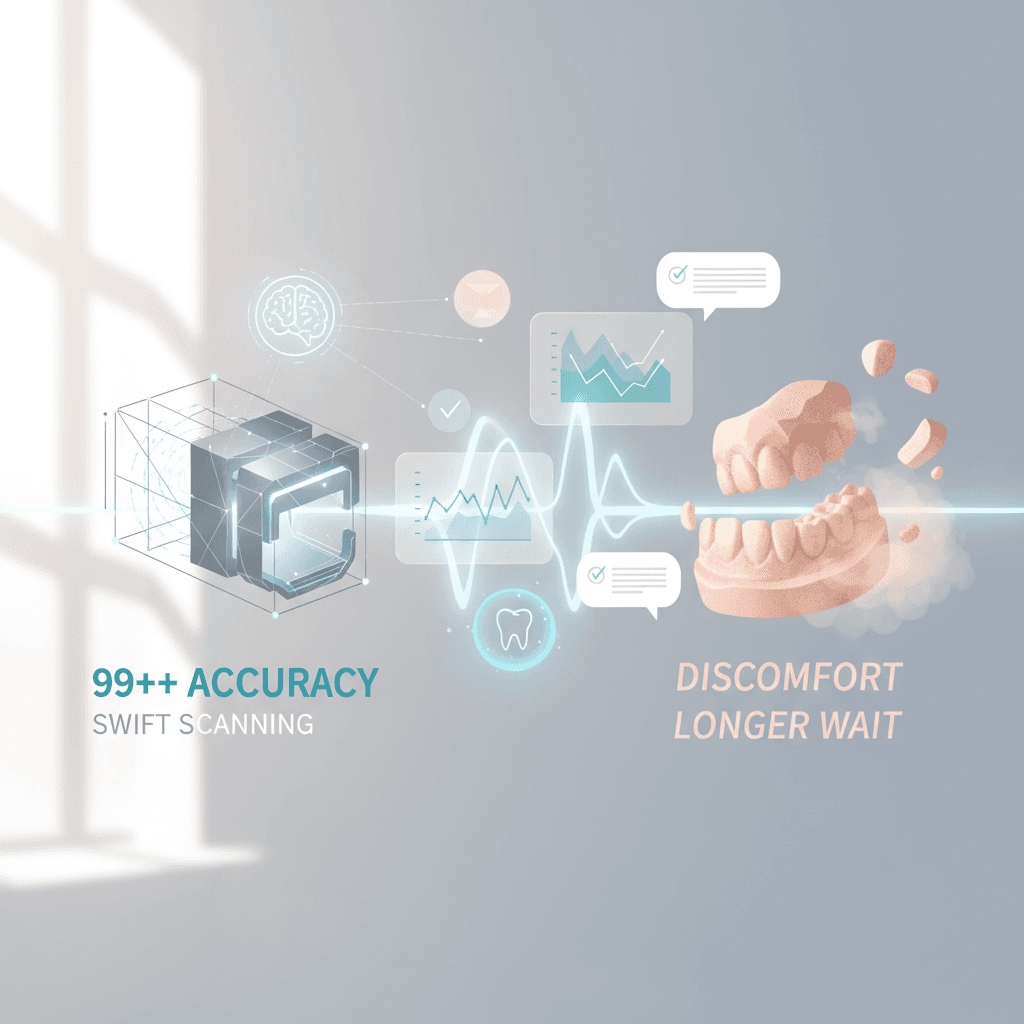
| Accuracy | 99%+ reproducibility | 92-96% accuracy range |
| Patient Comfort | No gag reflex triggers | Material taste, gagging common |
| Chair Time | 2-6 minutes scanning | 8-12 minutes setting time |
| Remake Rate | 2-3% cases | 15-20% cases |
| Storage | Digital archive, instant access | Physical storage, degradation |
Digital workflows eliminate the most common patient complaint about dental visits, uncomfortable impression materials. Practices report 21% fewer missed appointments when patients know digital scanning will be used instead of traditional trays.
The efficiency gains compound across high-value treatments. Invisalign cases processed with digital impressions in dentistry show 18% faster treatment starts and 31% higher case acceptance rates, directly impacting practice revenue streams. For more ideas on how to promote your digital services, explore these dental marketing ideas.
Wondering what AI tells patients about your practice? Free one page report in 48 hours. Where you are cited, where competitors win, and the gap.
Get your free AI Visibility CheckHow Digital Impressions Work, From Patient to Lab
Appointment Preparation
Optimal scanning requires dry field maintenance and tissue management. Apply retraction gel 3 minutes prior to scanning for precise margin capture. Remove any temporary restorations and ensure proper lighting for accurate colour mapping.
Scanning Workflow Steps
- Patient positioning: Semi-upright position reduces saliva pooling and improves scanner access.
- Arch scanning: Begin with mandibular arch, 20+ overlapping passes for complete coverage.
- Bite registration: Capture centric occlusion with 3-5 bite scans from different angles.
- Quality verification: Real-time scan review identifies gaps requiring additional passes.
Complete digital dental impressions typically require 40 seconds to 6 minutes depending on case complexity. Full-mouth rehabilitations need comprehensive tissue detail, while single-unit restorations focus on preparation margins and adjacent contacts.
File Transfer and Integration
Encrypted STL files transfer directly to dental labs through secure portals. Leading UK labs receive files within minutes, enabling same-day case processing for urgent treatments. Integration with practice management software automatically updates patient records and treatment timelines.
Applications in Modern UK Dental Practice
Invisalign and Clear Aligner Therapy
Digital impression dental technology revolutionises orthodontic treatment planning. Precise tooth positioning data enables accurate aligner fabrication, reducing the 12-15% refinement rate common with traditional impressions. Patients visualise treatment outcomes immediately, improving case acceptance by 27%.
Dental Implant Planning
Implant success depends on precise positioning relative to anatomical structures. Digital scans capture emergence profiles and tissue architecture with micron-level accuracy. Integration with CBCT data creates comprehensive surgical guides, reducing implant complications by 34% compared to freehand placement.
Complex Restorative Cases
Full-mouth rehabilitations benefit enormously from digital workflows. Scans capture vertical dimension, facial support, and aesthetic parameters simultaneously. Laboratory communication improves dramatically, with digital files enabling precise shade matching and margin verification before delivery. The technology particularly excels in complex interdisciplinary cases where multiple specialists require access to identical anatomical data.
Periodontal applications represent another frontier for digital impression dentistry. Crown lengthening procedures, gingival recontouring, and regenerative treatments benefit from precise tissue mapping capabilities. Digital scans capture subtle tissue contours that traditional impressions often distort or miss entirely.
Choosing Your Digital Impression System, Brands, Features, and ROI Analysis (2025 UK Edition)
Scanner selection determines your practice’s digital impression success. Intraoral scanners suit chairside workflows and immediate patient engagement, whilst desktop scanners offer superior resolution for complex laboratory work. Most successful UK practices deploy hybrid systems combining both technologies.
Key evaluation criteria include scan speed, file compatibility, and service support within the UK. Wireless connectivity enables flexible positioning, whilst AI-powered error correction reduces rescan requirements. Integration with existing practice management software streamlines patient records and billing workflows.
| Scanner System | Scan Speed | Wireless Capability | UK Support Network | CAD/CAM Integration | Best Application |
|---|---|---|---|---|---|
| iTero Element 5D Plus | 20 seconds full arch | Yes | Extensive | Invisalign native | Orthodontic workflows |
| 3Shape TRIOS 4 | 15 seconds full arch | Yes | Comprehensive | Universal | Multi-specialty practices |
| Medit i700 | 25 seconds full arch | Yes | Growing | Open architecture | Cost-conscious practices |
| Planmeca Emerald S | 30 seconds full arch | Optional | Established | Planmeca ecosystem | Integrated dental units |
ROI calculations must factor initial investment, training costs, and ongoing software subscriptions. Most UK practices achieve breakeven within 18-24 months through reduced remake rates and increased treatment acceptance. Dominate Dental’s client data shows practices implementing digital impression dentistry experience 31% higher conversion rates on complex treatment plans, with average case values increasing by £847 per patient. For additional insight into optimising your online presence, read about how dental SEO can lead to more patients.
Enhancing Patient Experience & Practice Efficiency Through Digital Impressions
Digital impression dentistry transforms patient comfort through elimination of traditional impression materials. Patients avoid gagging, taste sensitivity, and claustrophobic sensations associated with impression trays. The visual feedback from real-time scanning creates engagement, with 94% of patients rating the experience as superior to conventional methods.
Chairside efficiency gains compound throughout the practice day. Digital workflows eliminate impression material mixing, tray selection, and setting time delays. Average appointment duration decreases by 12-15 minutes per complex case, enabling additional patient scheduling or extended consultation time for treatment planning discussions.
Measurable Efficiency Improvements
- 8+ hours weekly time savings through eliminated material handling
- 67% reduction in impression retakes and remakes
- 23% increase in same-day treatment plan acceptance
- £2,340 monthly revenue increase per scanner (average UK practice)
Visual treatment communication revolutionises patient education. Digital scans enable immediate 3D model display, allowing patients to understand their dental anatomy and proposed treatments. This transparency increases informed consent rates and reduces treatment anxiety, particularly valuable for high-value procedures like dental implants and orthodontic treatment. To further boost your digital presence, effective social media for dentists can help educate and engage patients.
Common Problems in Digital Impression Dentistry, and How to Solve Them
Scan quality issues typically stem from inadequate tissue preparation or operator technique. Saliva contamination is the most common cause of scanning failures, which can be resolved through proper isolation and tissue management protocols. Pre-scan preparation should include thorough drying, retraction cord placement where indicated, and patient positioning optimisation. For best practices, always follow the GDC principles.
Gag reflex management requires systematic approach modification. Begin scanning from posterior regions using swift, confident movements. Maintain scanner tip 2-3mm from tissue surfaces and avoid prolonged contact with palatal areas. Patients benefit from breathing instruction and distraction techniques during the scanning process.
Software integration challenges often arise during the initial implementation phases, particularly when verifying file format compatibility between scanners and laboratory systems before case submission. Digital marketing manager at Dominate Dental ensures technical integration services resolve connectivity issues and establish seamless workflows between practice management systems and digital impression platforms, guaranteeing smooth data transfer and accurate case tracking.
Calibration and maintenance protocols prevent most technical difficulties. Weekly scanner calibration takes under 5 minutes but prevents costly scan failures and patient appointment delays. Regular tip cleaning and software updates maintain optimal performance, with monthly deep cleaning recommended for high-volume practices. For further reading, see this NHS case study on how new technology improves patient experience at Musgrove.
Data Management, Security & Digital Compliance in UK Dental Practice
GDPR compliance governs all digital impression data storage and transmission within UK dental practices. Patient scan files constitute personal health information requiring encrypted storage, controlled access, and defined retention periods. Practices must implement audit trails documenting file access, modification, and sharing activities.
Digital Security Protocols and Best Practices
Digital security protocols require multi-layered protection beyond basic GDPR compliance. Implement end-to-end encryption for all scan transfers, with minimum AES-256 standards for file storage. Staff access controls should follow the principle of least privilege, treatment coordinators access patient scans only, while practice owners maintain full system oversight.
Regular security audits every six months identify vulnerabilities before they compromise patient data. Automated backup systems with 3-2-1 redundancy (three copies, two different media, one offsite) protect against ransomware attacks targeting healthcare data. Cloud storage providers must demonstrate ISO 27001 certification and UK data residency guarantees. For a deeper dive into compliance and standards, review the FGDP Standards in Dentistry.
Critical Security Checklist
- Two-factor authentication for all scanner access
- Encrypted file transfer protocols (SFTP/HTTPS only)
- Quarterly staff security training updates
- Incident response plan with 72-hour breach notification