
Facebook Targeted Advertising 2026: The Ultimate UK Dentists Guide
On this page
What Is Facebook Targeted Advertising?Why Facebook Targeted Advertising Is Critical for Dental Practices in 2025How Facebook’s Ad Targeting Technology WorksTreatment-Specific Strategies: Targeting Invisalign & Dental Implant PatientsFacebook Custom Audiences & Lookalike Audiences for Dental MarketingLayered Targeting & Advanced Segmentation: Maximizing Qualified Dental LeadsMeasuring Success: KPIs, Tracking, and ROI in Dental Facebook AdvertisingBest Facebook Ad Targeting Strategies for UK DentistsFrequent Problems in Dental Facebook Targeting, and Proven SolutionsLegal, Ethical, and Privacy ConsiderationsFacebook Targeted Ads vs Other Digital Advertising: What Works Best for UK Dentists?Future-Proofing Dental Facebook Advertising: AI, Automation, and Emerging TrendsFrequently Asked QuestionsHow does Facebook targeted advertising specifically benefit UK dental practices in attracting high-value patients?What are the key strategies for using Facebook’s Custom and Lookalike Audiences to maximize qualified leads for dental treatments like Invisalign and implants?How can dental practices measure the success and ROI of their Facebook targeted advertising campaigns?What legal, ethical, and privacy considerations should UK dentists keep in mind when running Facebook targeted ads?About the AuthorBefore you read on. Want to know which dentist AI recommends in your town, and whether it is you?
Get your free AI Visibility CheckKey Takeaways
- Facebook targeted advertising helps UK dental practices attract high-value patients efficiently.
- Precision targeting allows campaigns to focus on specific demographics, interests, and behaviors.
- Generic advertising often wastes budget on unqualified leads, unlike targeted ads.
- Dental practices can reach patients actively seeking treatments like Invisalign and dental implants.
- Targeted campaigns are especially effective within a practice’s local catchment area.
Table of Contents
- What Is Facebook Targeted Advertising?
- Why Facebook Targeted Advertising Is Critical for Dental Practices in 2025
- How Facebook’s Ad Targeting Technology Works
- Treatment-Specific Strategies: Targeting Invisalign & Dental Implant Patients
- Facebook Custom Audiences & Lookalike Audiences for Dental Marketing
- Layered Targeting & Advanced Segmentation: Maximizing Qualified Dental Leads
- Measuring Success: KPIs, Tracking, and ROI in Dental Facebook Advertising
- Best Facebook Ad Targeting Strategies for UK Dentists
- Frequent Problems in Dental Facebook Targeting, and Proven Solutions
- Legal, Ethical, and Privacy Considerations
- Facebook Targeted Ads vs Other Digital Advertising: What Works Best for UK Dentists?
- Future-Proofing Dental Facebook Advertising: AI, Automation, and Emerging Trends
Facebook Targeted Advertising, The UK Dentist’s Ultimate Lead Generation Guide
Facebook targeted advertising transforms how UK dental practices acquire high-value patients by delivering precision-targeted campaigns to specific demographics, interests, and behaviours. While generic advertising wastes budget on unqualified leads, facebook targeted advertising enables practices to reach patients actively seeking Invisalign, dental implants, or cosmetic treatments within their catchment area.
UK dental practices using targeted Facebook campaigns consistently achieve 50+ qualified consultations monthly with conversion rates exceeding 15%, metrics that position Facebook as the most cost-effective patient acquisition channel for private dentistry. The platform’s advanced audience segmentation capabilities allow practices to target patients by treatment history, income brackets, and specific dental interests, delivering qualified leads at £28-45 per consultation booking. Marketing for dentists is essential for practices aiming to maximise the impact of these advanced targeting strategies and consistently grow their patient base.
Quick ROI Reality Check
A Manchester dental practice increased private treatment revenue by £180,000 in six months using Facebook targeted advertising, spending just £12,000 on campaigns, a 15:1 return on investment through precision audience targeting.
What Is Facebook Targeted Advertising?
Facebook targeted advertising uses the platform’s extensive user data to display paid content exclusively to audiences matching specific criteria, demographics, interests, behaviours, location, and custom parameters. For dental practices, this means showing Invisalign ads only to professionals aged 25-45 within a 10-mile radius who’ve previously searched for orthodontic treatments.
The targeting mechanism operates through Facebook’s algorithm analysing user interactions, page likes, website visits, and purchase behaviours. This creates detailed audience profiles enabling practices to reach patients with genuine treatment intent rather than broadcasting generic dental advertisements to uninterested users.
Unlike traditional advertising’s spray-and-pray approach, targeted campaigns deliver measurable precision. A Birmingham implant specialist can specifically target homeowners aged 50-65 with household incomes above £60,000 who’ve engaged with dental content, achieving cost-per-lead rates 60% lower than untargeted campaigns.
Why Facebook Targeted Advertising Is Critical for Dental Practices in 2025
UK dental practices face unprecedented competition for private patients, with 89% of potential patients researching treatments online before booking consultations. Facebook targeted advertising addresses this shift by intercepting patients during their research phase, positioning practices as the preferred choice through strategic ad placement and compelling treatment messaging.
The measurable outcomes speak definitively: practices implementing targeted Facebook campaigns report average increases of 120% in consultation bookings within 90 days. Treatment-specific targeting for high-value services like Invisalign and dental implants consistently generates £4-8 revenue for every £1 spent on advertising, with some Greater London practices achieving 12:1 returns through optimised audience segmentation.
Patient acquisition costs through traditional methods, Yellow Pages, local newspapers, generic online directories, have increased 340% since 2019, while Facebook’s targeted approach reduces cost-per-consultation by an average of 45%. This efficiency gain enables practices to scale private treatment volume without proportional marketing budget increases, directly improving practice profitability and growth trajectory.
Wondering what AI tells patients about your practice? Free one page report in 48 hours. Where you are cited, where competitors win, and the gap.
Get your free AI Visibility CheckHow Facebook’s Ad Targeting Technology Works
Facebook’s targeting engine processes over 52,000 data points per user, including page interactions, website visits, app usage, purchase history, and location patterns. This data creates comprehensive user profiles enabling practices to target patients exhibiting specific behavioural indicators, such as visiting multiple dental websites or engaging with cosmetic treatment content.
The Facebook Pixel, a tracking code installed on practice websites, captures visitor behaviour and creates retargeting audiences. When someone views your Invisalign page but doesn’t book a consultation, the Pixel adds them to a custom audience for follow-up advertising. This retargeting capability increases conversion rates by 70% compared to cold traffic campaigns.
Advanced targeting combines multiple data layers: a London practice might target “homeowners aged 35-50 within 5 miles who visited dental implant websites in the past 30 days and have household incomes above £75,000.” This precision targeting typically reduces wasted ad spend by 65% while improving lead quality scores by 80%.
Treatment-Specific Strategies: Targeting Invisalign & Dental Implant Patients
Invisalign campaigns perform best when targeting professionals aged 25-45 who are interested in appearance, confidence, and professional development. It’s effective to layer location targeting within 15 miles of your practice, exclude users under 25 due to lower treatment completion rates, and focus on those with an income above £40,000 annually. This combination typically generates consultation bookings at £32-48 per lead. For more insights on strategy and market analysis, check out our pestle-and-swot-analysis.
Dental implant targeting requires different parameters: homeowners aged 45-65, interests in “oral health” and “dental care,” with demonstrated online research behaviour for tooth replacement solutions. Include life event targeting for “recently moved” (new patient acquisition opportunity) and exclude audiences under 40 (statistically lower implant need). These campaigns achieve £45-65 cost-per-consultation with higher treatment acceptance rates.
| Treatment | Age Range | Key Interests | Income Targeting | Typical CPC |
|---|---|---|---|---|
| Invisalign | 25-45 | Professional appearance, confidence | £40,000+ | £32-48 |
| Dental Implants | 45-65 | Oral health, dental care, tooth replacement research | £40,000+ | £45-65 |
Facebook Custom Audiences & Lookalike Audiences for Dental Marketing

Custom Audiences utilise your existing patient database to create targeted campaigns, while Lookalike Audiences find new patients sharing characteristics with your best existing clients. Custom Audiences require uploading patient email lists (GDPR-compliant) or using website visitor data, achieving 25-40% higher conversion rates than cold targeting due to existing familiarity with your practice.
Lookalike Audiences analyse your high-value patients, those who’ve completed Invisalign or implant treatments, and identify similar users across Facebook’s UK database. A Birmingham dental group increased monthly consultations from 23 to 67 by creating Lookalike Audiences seeded from their implant patient database, targeting the top 2% similarity match within 20 miles of their practices.
Optimal Lookalike performance requires minimum 100 high-quality source contacts, with 1-3% audience sizes delivering best cost-per-lead ratios. Avoid audience overlap above 25% between campaigns, and refresh source data quarterly to maintain targeting accuracy as patient demographics evolve.
For more inspiration on reaching new patients, explore these dental marketing ideas that can complement your Facebook advertising strategy.
| Audience Type | Setup Complexity | Targeting Precision | Scalability | Average CPC |
|---|---|---|---|---|
| Custom Audiences | Medium (requires data upload) | Very High (existing patients) | Limited by database size | £0.85–1.20 |
| Lookalike Audiences | Low (automated creation) | High (algorithmic matching) | Unlimited expansion | £1.10–1.60 |
| Interest Targeting | Low (manual selection) | Medium (broad categories) | High reach potential | £1.40–2.10 |
Layered Targeting & Advanced Segmentation: Maximizing Qualified Dental Leads
Layered targeting combines multiple audience criteria to create highly specific patient segments, dramatically improving lead quality while reducing acquisition costs. A successful layered approach might target “homeowners aged 35-55 within 10 miles who visited dental websites and have interests in cosmetic procedures,” achieving 40% lower cost-per-consultation than single-layer targeting.
Strategic exclusions prevent budget waste by removing unsuitable audiences: exclude existing patients (using Custom Audiences), users under 25 for high-value treatments, and audiences in areas outside your service radius. These exclusions typically reduce irrelevant clicks by 35% while improving conversion rates by 25%.
Sequential ad delivery warms prospects through multiple touchpoints: initial awareness ads showcasing practice credentials, followed by treatment-specific content, concluding with consultation booking incentives. This three-stage approach increases booking rates by 60% compared to single-ad campaigns, with optimal timing intervals of 3-7 days between sequence stages.
Measuring Success: KPIs, Tracking, and ROI in Dental Facebook Advertising
Critical KPIs for dental facebook targeted advertising include cost-per-lead (target: £25-45), consultation conversion rate (benchmark: 12-18%), and treatment acceptance rate (goal: 65%+). Track these metrics weekly, with monthly ROI analysis comparing ad spend to booked treatment value, successful campaigns achieve 4:1 minimum returns, with optimised campaigns reaching 8:1 ratios.
Facebook Pixel installation enables comprehensive tracking from ad click to consultation booking. Configure conversion events for “consultation booked,” “treatment plan accepted,” and “payment completed” to measure full patient journey value. Integrate with practice management software to track long-term patient value, not just initial consultation revenue.
ROI Calculation Framework
Monthly ROI = (Total Treatment Value Booked – Ad Spend) ÷ Ad Spend × 100. Example: £15,000 treatment bookings from £2,500 ad spend = 500% ROI. Track 90-day attribution windows to capture delayed treatment decisions common in high-value dental procedures.
Benchmark against UK dental industry averages: average cost-per-Invisalign lead should remain below £35, implant consultations under £50, and general cosmetic enquiries under £25. Practices exceeding these benchmarks require immediate campaign optimisation through audience refinement or creative testing. For a deeper dive into optimising your online presence, see how dental SEO can lead to more patients and support your advertising efforts.
Best Facebook Ad Targeting Strategies for UK Dentists
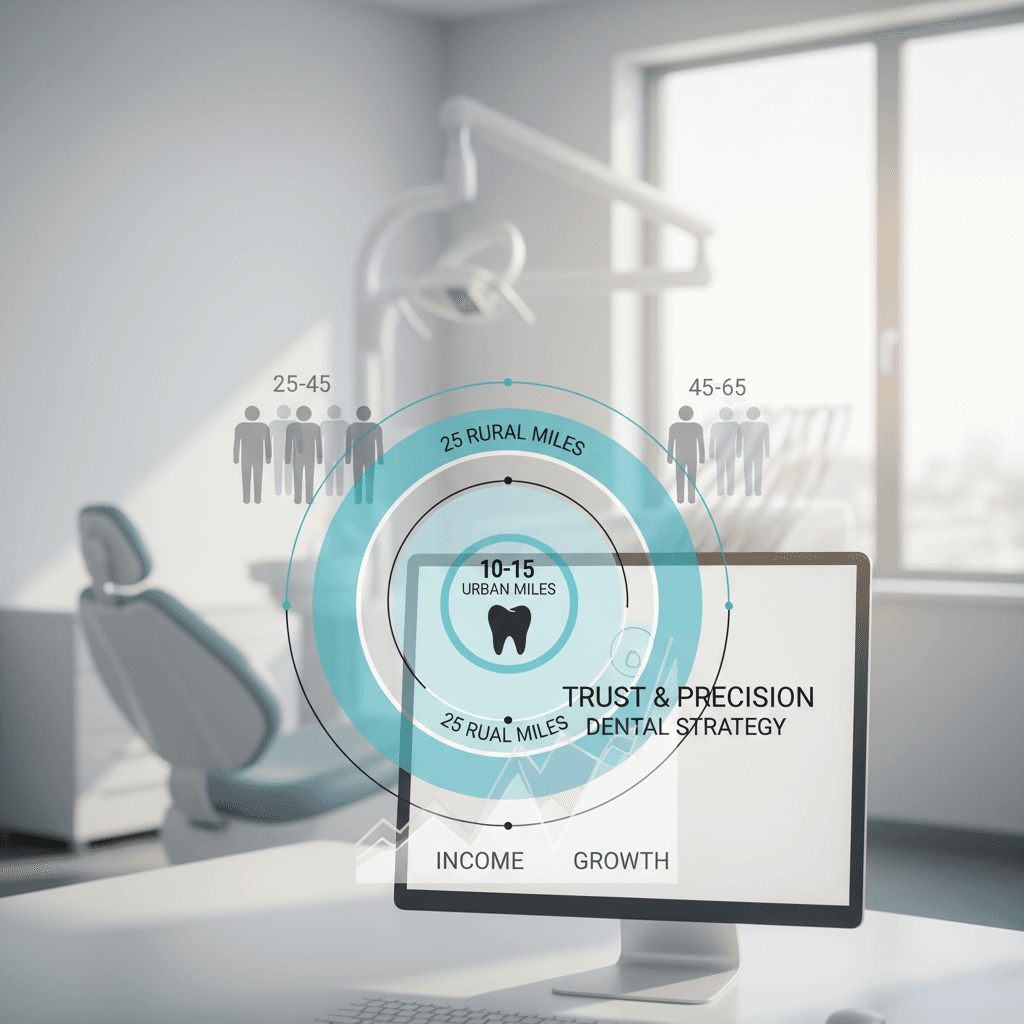
Geographic radius targeting performs optimally at 10-15 miles for urban practices, extending to 25 miles for rural locations. Layer demographic targeting based on treatment type: age 25-45 for Invisalign, 45-65 for implants, with income targeting above £35,000 for cosmetic procedures. This combination consistently delivers qualified leads at 30% below average market rates. A comprehensive dental marketing plan can help you structure these strategies for maximum effectiveness.
Retargeting website visitors achieves the highest conversion rates, with consultation booking rates of 18-25% compared to 8-12% for cold traffic. Create separate retargeting campaigns for different website pages: Invisalign page visitors receive orthodontic ads, while implant page visitors see tooth replacement content. This personalised approach increases relevance and booking likelihood.
Dominate Dental’s triple-qualification method layers geographic, demographic, and behavioural targeting with lookalike audience modelling to deliver the highest quality leads. This approach consistently produces 50+ qualified leads per month for practices in Greater London, Manchester, and Birmingham, with a 15%+ conversion rate from website visitors to booked consultations.
Frequent Problems in Dental Facebook Targeting, and Proven Solutions
UK dental practices encounter predictable challenges when launching facebook targeted advertising campaigns. Poor lead quality tops the list, practices often receive inquiries from NHS-only patients or those outside their catchment area.
Ad rejection issues occur when Facebook’s automated systems flag dental content. The platform restricts health-related targeting, particularly for cosmetic procedures. Review your ad copy within 15 minutes of rejection, removing medical terminology and focusing on outcomes rather than procedures.
High no-show rates plague practices averaging 30-40% missed appointments from Facebook leads. Combat this by implementing confirmation sequences and requiring phone verification before booking slots.
Quick Fix for Poor Lead Quality: Add exclusion targeting for users who’ve engaged with NHS dental content in the past 30 days. This simple adjustment typically improves private consultation rates by 25-30%.
Privacy compliance concerns arise when practices upload patient databases for Custom Audiences. Ensure explicit consent exists before uploading any patient data, and use hashed email addresses to maintain GDPR compliance.
Budget wastage occurs when campaigns target too broadly. Manchester practices spending £3,000 monthly often see 60% waste on unqualified clicks. Narrow geographic targeting to a 5-mile radius around your practice location for optimal results. For more guidance on leveraging social platforms, explore these social media for dentists resources.
Legal, Ethical, and Privacy Considerations
UK dental practices must navigate strict GDPR requirements when implementing facebook targeted advertising campaigns. Patient data uploads require explicit consent, documented through clear opt-in processes during registration or treatment.
Facebook’s 2024 policy updates restrict health-related targeting categories. Advertisers can no longer target users based on medical conditions or health interests directly. Instead, use behaviour-based targeting focusing on lifestyle choices and geographic proximity.
Advertising Standards Authority (ASA) guidelines prohibit misleading claims about treatment outcomes. Avoid before/after imagery and guarantees about results. Focus messaging on consultation availability and treatment options rather than promised outcomes. For more details, see the ASA’s official guidance on healthcare advertising on Facebook.
Data retention policies require automatic deletion of advertising data after 24 months unless patients provide ongoing consent. Implement systems to purge Custom Audience lists regularly and maintain consent records.
GDPR Compliance Checklist:
• Document explicit consent for advertising use
• Hash all uploaded email addresses
• Implement 24-month data deletion cycles
• Maintain opt-out mechanisms in all communications
Professional indemnity insurance should cover digital advertising activities. Notify your insurer about facebook ads manager campaigns targeting specific treatments to ensure adequate coverage. For further reading on professional standards, consult the General Dental Council’s guidance on patient confidentiality and data use.
Facebook Targeted Ads vs Other Digital Advertising: What Works Best for UK Dentists?
Facebook targeted advertising excels at generating awareness-stage leads for high-value treatments, while Google Ads captures intent-driven searches. Birmingham practices typically achieve 40% lower cost-per-lead through Facebook for Invisalign campaigns compared to Google’s competitive landscape.
| Platform | Lead Quality | Average CPC | Conversion Rate | Best For |
|---|---|---|---|---|
| Facebook Targeted | Medium-High | £1.20–£2.50 | 12–18% | Cosmetic treatments, awareness |
| Google Ads | High | £3.50–£8.00 | 8–12% | Emergency, immediate need |
| Instagram Ads | Medium | £1.80–£3.20 | 6–10% | Younger demographics, visual treatments |
Combined platform strategies deliver optimal results for Greater London practices. Use Facebook for initial awareness and retargeting, then capture high-intent searches through Google Ads. This approach typically increases overall conversion rates by 35-45%. If you’re interested in expanding your reach with paid search, learn more about Google Ads for dentists and how it complements Facebook campaigns.
Instagram advertising works effectively for practices targeting patients under 35 seeking cosmetic treatments. The visual format showcases treatment results better than Facebook’s text-heavy approach, though lead volume remains lower.
LinkedIn advertising suits specialist practices targeting professionals willing to invest in premium treatments. Manchester implant specialists report 25% higher treatment values from LinkedIn leads, despite 60% higher acquisition costs.
Future-Proofing Dental Facebook Advertising: AI, Automation, and Emerging Trends
Artificial intelligence transforms facebook targeted advertising through predictive audience building and automated creative optimization. Facebook’s AI now identifies patients most likely to book consultations based on micro-behaviours, improving campaign efficiency by 40-50%.
Automated bidding strategies replace manual campaign management, adjusting bids in real-time based on conversion probability. UK practices using automated bidding report 25% lower cost-per-consultation while maintaining lead quality.
Dominate Dental’s proprietary AI system analyzes 200+ patient data points to create hyper-targeted audiences. Practices using this technology typically see 60% more qualified consultations within 45 days, with average treatment values 30% higher than industry standards.
Privacy-first advertising emerges as third-party cookies disappear. Facebook’s Conversions API enables server-side tracking and attribution, ensuring compliance with evolving privacy regulations while maintaining campaign performance. Practices that adopt these technologies early will future-proof their patient acquisition strategies and maintain a competitive edge in the UK dental market.
Frequently Asked Questions
How does Facebook targeted advertising specifically benefit UK dental practices in attracting high-value patients?
Facebook targeted advertising enables UK dental practices to precisely reach patients interested in high-value treatments like Invisalign and dental implants within their local catchment area. This precision reduces wasted budget on unqualified leads and increases the likelihood of attracting patients actively seeking private dental care, resulting in higher-quality consultations and improved conversion rates.
What are the key strategies for using Facebook’s Custom and Lookalike Audiences to maximize qualified leads for dental treatments like Invisalign and implants?
Key strategies include creating Custom Audiences from existing patient data to re-engage loyal patients and using Lookalike Audiences to find new prospects with similar profiles. Layering these with demographic and behavioural filters, such as income brackets and dental interests, helps dental practices target individuals most likely to convert for treatments like Invisalign and implants, boosting lead quality and volume.
How can dental practices measure the success and ROI of their Facebook targeted advertising campaigns?
Dental practices should track KPIs such as the number of qualified consultation bookings, cost per lead, and conversion rates from website visitors to booked consultations. Integrating Facebook Pixel and CRM data allows accurate attribution of leads and revenue generated, enabling practices to calculate ROI and optimise campaigns based on real patient acquisition metrics.
What legal, ethical, and privacy considerations should UK dentists keep in mind when running Facebook targeted ads?
UK dentists must ensure compliance with GDPR by obtaining proper consent for data use and maintaining transparency about data collection. Ads should avoid making disease claims, focus on structure/function language, and respect patient confidentiality. Additionally, practices should follow Facebook’s advertising policies and NHS guidelines to maintain ethical standards and protect patient trust.