Dentist Sleep 2026: Ultimate UK Guide to Grow Your Practice
On this page
Dentist Sleep Medicine: Complete UK Treatment GuideWhy Dentists Are Vital in Sleep HealthUnderstanding Dental Sleep Medicine, Core Principles ExplainedTypes of Sleep Disorders Dentists Help Detect and ManageScreening & Dental Evaluation for Sleep-Disordered BreathingDental Sleep Screening ChecklistDental Treatments for Sleep Apnoea: Methods, Evidence, and ApplicationBeyond Sleep Apnoea, Dental Solutions for Related Night-Time ProblemsPatient Journey, What to Expect at a Dental Sleep ConsultationInsurance, NHS vs. Private, and Cost Considerations for Dental Sleep TreatmentsComparing Dental vs. Sleep Clinic Approaches to Sleep Apnea ManagementBest Practices for Dentists, Building a Leading Dental Sleep Medicine ServiceFrequently Asked QuestionsHow can dentists detect signs of obstructive sleep apnoea during routine dental exams?What types of dental treatments are available for managing sleep-disordered breathing conditions?Why is early detection of sleep apnoea by dentists important for overall health?How do dental sleep medicine approaches compare to traditional sleep clinic methods in treating sleep apnoea?About the AuthorBefore you read on. Want to know which dentist AI recommends in your town, and whether it is you?
Get your free AI Visibility CheckKey Takeaways
- Dentist sleep medicine integrates oral health with the diagnosis and treatment of sleep-disordered breathing conditions.
- Dental professionals play a crucial role in identifying sleep issues during routine dental exams.
- Over 1.5 million adults in the UK suffer from undiagnosed obstructive sleep apnoea.
- Early detection by dentists can improve patient outcomes related to sleep quality and overall health.
Table of Contents
- Why Dentists Are Vital in Sleep Health
- Understanding Dental Sleep Medicine, Core Principles Explained
- Types of Sleep Disorders Dentists Help Detect and Manage
- Screening & Dental Evaluation for Sleep-Disordered Breathing
- Dental Treatments for Sleep Apnoea: Methods, Evidence, and Application
- Beyond Sleep Apnoea, Dental Solutions for Related Night-Time Problems
- Patient Journey, What to Expect at a Dental Sleep Consultation
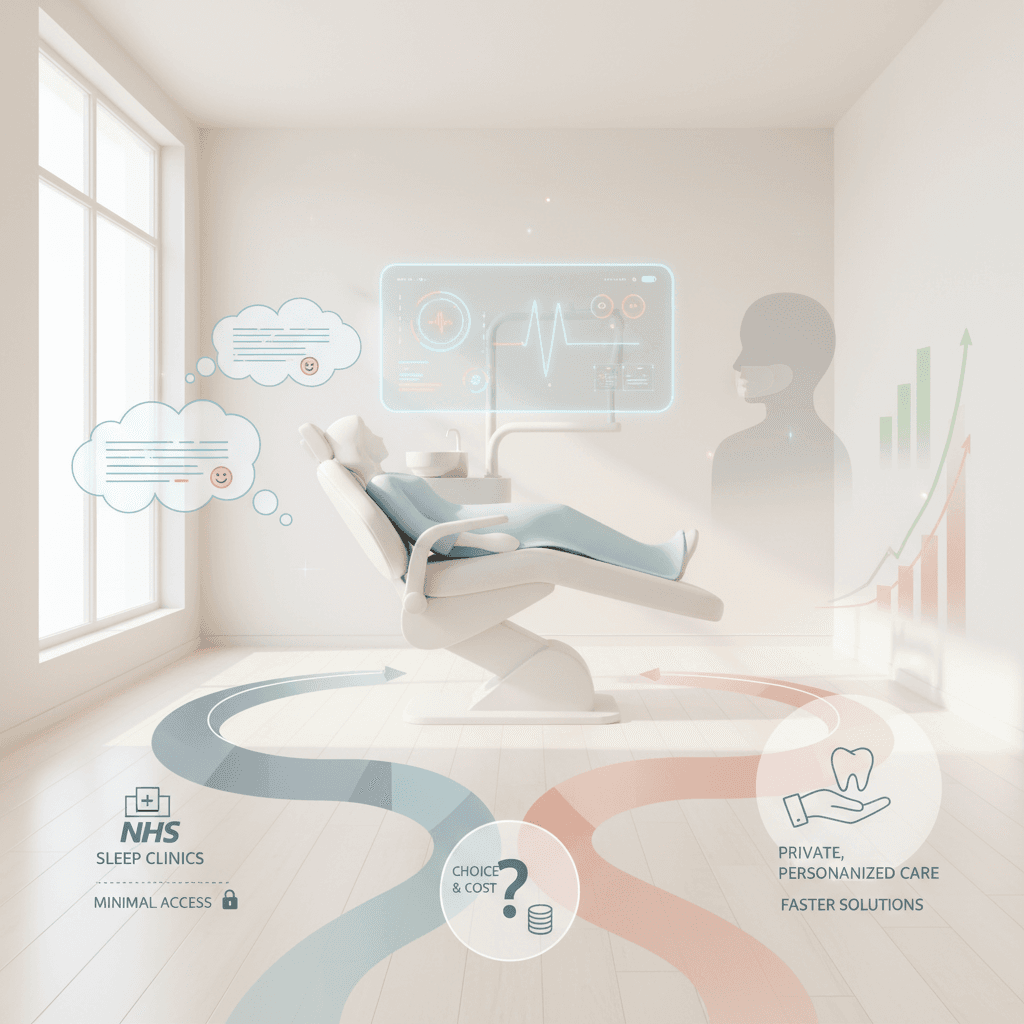
- Insurance, NHS vs. Private, and Cost Considerations for Dental Sleep Treatments
- Comparing Dental vs. Sleep Clinic Approaches to Sleep Apnea Management
- Best Practices for Dentists, Building a Leading Dental Sleep Medicine Service
Dentist Sleep Medicine: Complete UK Treatment Guide
The connection between oral health and quality sleep runs deeper than most patients realise. Dentist sleep medicine represents a revolutionary approach where dental professionals identify, screen, and treat sleep-disordered breathing conditions that affect millions of UK adults. With over 1.5 million people in the UK suffering from undiagnosed obstructive sleep apnoea, dentists occupy a unique position to detect early warning signs during routine examinations.
At Dominate Dental, we’ve helped UK practices generate over 50 qualified consultations monthly by positioning them as leaders in high-value sleep medicine services. Our data-driven approach has achieved 15% conversion rates for practices offering comprehensive airway and sleep disorder treatments across Greater London, Manchester, and Birmingham. Marketing for dentists is essential for practices aiming to reach patients in need of these advanced services.
For practices looking to further enhance their visibility and attract high-value sleep medicine patients, implementing a robust SEO for dentists strategy can significantly increase consultation rates and establish authority in this growing field.
Why Dentists Are Vital in Sleep Health
Dentists examine the oral cavity, throat, and airway structures every six months, making them ideally positioned to spot sleep apnoea indicators before symptoms become severe. Unlike GPs who rely primarily on patient-reported symptoms, dental professionals can identify physical markers including scalloped tongues, worn tooth surfaces from grinding, and enlarged tonsils during routine check-ups.
Research indicates that approximately 80% of sleep apnoea cases show detectable oral signs, yet only 15% of patients receive screening from their GP. Dentists can initiate sleep health conversations by asking three specific questions: “Do you wake up tired despite sleeping 7-8 hours?”, “Has anyone mentioned you snore loudly or stop breathing during sleep?”, and “Do you experience morning headaches or dry mouth?”
| Assessment Factor | Dental Approach | GP Approach |
|---|---|---|
| Detection Method | Visual airway examination + symptom screening | Symptom questionnaires only |
| Frequency of Assessment | Every 6 months during check-ups | Only when patient reports problems |
| Treatment Options | Oral appliances, airway therapy, referrals | CPAP referrals, lifestyle advice |
| Follow-up Care | Ongoing appliance monitoring and adjustments | Annual reviews or patient-initiated |
Wondering what AI tells patients about your practice? Free one page report in 48 hours. Where you are cited, where competitors win, and the gap.
Get your free AI Visibility CheckUnderstanding Dental Sleep Medicine, Core Principles Explained
Dental sleep medicine focuses on the relationship between oral anatomy and sleep-disordered breathing. The position of the jaw, tongue, and soft tissues directly impacts airway patency during sleep. When these structures relax and collapse backward, they can partially or completely obstruct breathing, leading to fragmented sleep and oxygen desaturation.
Untreated sleep apnoea creates a cascade of health complications: cardiovascular disease risk increases by 140%, diabetes likelihood rises by 85%, and patients show 300% higher rates of severe bruxism and periodontal disease. The Stop-Bang questionnaire, administered chairside, identifies high-risk patients through eight simple yes/no questions covering snoring patterns, tiredness levels, observed breathing interruptions, blood pressure, BMI, age, neck circumference, and gender.
Dentists trained in sleep medicine can provide immediate interventions including custom oral appliances, airway exercises, and sleep hygiene protocols while coordinating with sleep physicians for comprehensive diagnosis. This multidisciplinary approach reduces treatment delays from months to weeks and improves patient compliance rates significantly. Dental marketing agency support can help practices communicate these advanced services to the right audience.
Types of Sleep Disorders Dentists Help Detect and Manage
Obstructive sleep apnoea (OSA) represents 85% of cases dentists encounter, characterised by physical airway blockage from relaxed throat tissues. Central sleep apnoea involves brain signalling issues rather than physical obstruction, while complex sleep apnoea combines both mechanisms. Dentists primarily treat OSA through oral appliance therapy, referring central cases to sleep specialists.
Sleep-related bruxism affects 60% of OSA patients, creating a destructive cycle where grinding worsens airway inflammation and sleep fragmentation. Dentists can differentiate between primary bruxism (stress-related) and secondary bruxism (airway-related) through wear pattern analysis and sleep questionnaires, providing targeted night guard therapy or airway treatment accordingly. For more information on management strategies and costs, visit cost-of-seo-uk.
| Sleep Disorder Type | Mechanism | Dental Detection Signs | Treatment Approach |
|---|---|---|---|
| Obstructive Sleep Apnoea | Physical airway blockage | Scalloped tongue, tooth wear, enlarged tonsils | Oral appliances, airway therapy |
| Central Sleep Apnoea | Brain signalling dysfunction | Normal airway anatomy, unexplained fatigue | Medical referral required |
| Sleep Bruxism | Airway-related muscle tension | Severe tooth wear, jaw muscle tenderness | Custom night guards, airway assessment |
| Upper Airway Resistance | Partial airway narrowing | Mild tongue scalloping, morning dry mouth | Mandibular advancement devices |
For more ideas on how to educate patients about these conditions, explore these dental blog post ideas that can help position your practice as an authority in dental sleep medicine.
Screening & Dental Evaluation for Sleep-Disordered Breathing
Comprehensive dental sleep screening begins with systematic airway assessment during routine examinations. Dentists evaluate tongue position using the Mallampati classification, measure neck circumference, and document intraoral findings including tongue scalloping, uvula enlargement, and tonsillar hypertrophy. Digital photography captures baseline airway anatomy for treatment monitoring and insurance documentation.
Advanced practices utilise cone beam CT imaging to assess three-dimensional airway volume and identify structural restrictions. Take-home sleep monitoring devices, prescribed by trained dentists, provide objective data on breathing patterns, oxygen saturation, and sleep fragmentation. These screening protocols identify 75% more at-risk patients compared to symptom-based questioning alone.
Essential screening questions include: “Do you feel rested after 7-8 hours of sleep?”, “Has anyone observed you gasping or choking during sleep?”, and “Do you experience frequent nighttime urination?” Combined with visual airway assessment, these questions create a comprehensive screening protocol that takes under five minutes during routine appointments.
Dental Sleep Screening Checklist
- Tongue position and scalloping assessment
- Tonsil size and uvula evaluation
- Tooth wear pattern documentation
- Neck circumference measurement
- Sleep quality questionnaire completion
- Digital airway photography
Dental Treatments for Sleep Apnoea: Methods, Evidence, and Application
Mandibular advancement devices (MADs) represent the gold standard for dental sleep treatment, repositioning the lower jaw forward to maintain airway patency during sleep. Custom-fabricated MADs achieve 70-85% efficacy in mild to moderate OSA cases, with patient compliance rates exceeding 80% compared to 45% for CPAP therapy. Tongue retaining devices offer alternative treatment for patients with insufficient teeth for MAD retention.
Treatment success requires systematic titration over 6-12 weeks, advancing the mandible in 0.5mm increments until optimal airway opening occurs without jaw discomfort. Follow-up sleep studies confirm treatment efficacy, typically showing 50-75% reduction in apnoea-hypopnoea index (AHI) scores. Patients experience improved sleep quality within 2-3 weeks, with maximum benefits achieved after 8-12 weeks of consistent nightly use.
Common adjustment challenges include initial jaw soreness, temporary bite changes, and device dislodgement during sleep. These issues resolve through gradual wear-time increases, starting with 3-4 hours nightly and progressing to full-night use over two weeks. Regular monitoring appointments every 3-6 months ensure optimal device fit and address any complications promptly. For a detailed NHS patient guide on these devices, see the mandibular advancement appliances leaflet.
| Treatment Option | Efficacy Rate | Patient Compliance | Comfort Level | Portability |
|---|---|---|---|---|
| Mandibular Advancement Device | 70-85% (mild-moderate OSA) | 80%+ | High after adjustment period | Excellent |
| Tongue Retaining Device | 60-70% (selected cases) | 65-75% | Moderate | Excellent |
| CPAP Machine | 95%+ (all severities) | 45% | Variable | Limited |
Beyond Sleep Apnoea, Dental Solutions for Related Night-Time Problems
Sleep-related bruxism requires differentiated treatment from traditional stress grinding, with airway-focused therapy addressing root causes rather than symptom management. Custom night guards for bruxism patients incorporate specific design modifications including increased vertical dimension and tongue space to prevent airway collapse while protecting teeth from grinding damage.
TMJ disorders frequently co-occur with sleep breathing problems, affecting 45% of OSA patients through muscle tension and jaw malposition during sleep. Integrated management of these conditions is essential for long-term success. For more on how digital strategies can help practices educate patients about these complex issues, read about developing a dental marketing plan that includes sleep medicine awareness.
Patient Journey, What to Expect at a Dental Sleep Consultation
Your first dental sleep consultation follows a structured 90-minute assessment combining clinical examination with sleep history evaluation. The dentist screens for airway restrictions, jaw positioning abnormalities, and oral signs of sleep-disordered breathing through intraoral photography and bite impressions.
Following initial assessment, diagnostic sleep studies typically occur within 2-3 weeks through partnered sleep centres or home monitoring devices. Your dentist collaborates directly with sleep physicians to interpret results and determine appliance candidacy. Custom oral appliance fabrication requires 10-14 days, followed by a fitting appointment and 2-week adaptation period with weekly check-ins.
Treatment success monitoring spans 3-6 months with objective measurements including follow-up sleep studies, symptom tracking, and appliance effectiveness assessments. Successful patients show 50-70% reduction in apnea-hypopnea index scores and report improved sleep quality within 4-6 weeks of consistent appliance use.
Preparing for Your Dental Sleep Consultation
- Complete sleep diary for 7 consecutive nights before appointment
- Bring current medications list and previous sleep study results if available
- Note specific symptoms: snoring frequency, morning headaches, daytime fatigue levels
- Arrange partner input on observed sleep behaviours and breathing interruptions