Dominate Dental · Blog
Practice growthLinkedIn Dental Marketing 2026: The Ultimate Growth Guide for Dentists
On this page
Why LinkedIn Dental Marketing Matters for UK Practices Focused on High-Value CasesWhat “LinkedIn Dental Marketing” Actually Is (B2B + B2C Clarified)Core Benefits of LinkedIn for Dental Practices (With Timeframes & Metrics)Building a High-Performing Dentist LinkedIn Profile That Attracts Referrals & Private PatientsStrategic Profile Setup: From “Online CV” to “Mini Landing Page”Crafting a Magnetic Headline & About Section (With Formulas)Images, Banner, and Visual Consistency With Your Dental WebsiteSocial Proof: Recommendations, Endorsements & Ethical Ask ScriptsLinkedIn Content Strategy for Dentists: What to Post, How Often, and For WhomDefining Your Core Audiences on LinkedInContent Types That Work for Dental Practices (With Concrete Examples)Posting Cadence and Best Times for UK Dental PracticesBuilding a 30-Day LinkedIn Content Calendar for a Dental ClinicNetworking, Referrals, and Outreach: Turning Connections into RevenueBuilding a Targeted Network in 15 Minutes a DayOutreach Scripts for Referral Partners & Local EmployersUsing LinkedIn Groups & Events to Grow Your Dental BrandLinkedIn Ads for Dental Practices: When to Use Them and How to Target CorrectlyWhen LinkedIn Ads Make Sense for a Local Dental ClinicTargeting Local Professionals and Referrers With PrecisionAnalytics, ROI, and Integrating LinkedIn Into Your Wider Dental Marketing StrategyWhat to Track: The Right LinkedIn KPIs for Dental ClinicsMeasuring LinkedIn ROI in Real-World NumbersIntegrating LinkedIn With Dental SEO, Website & CRMCompliance, Ethics, and Reputation Management on LinkedIn for DentistsGDC, Confidentiality & Privacy Considerations in the UK ContextHandling Negative Comments and Criticism ProfessionallyFrequently Asked QuestionsHow does LinkedIn dental marketing help UK dental practices attract high-value patients and build referral networks?What types of dental cases and patient demographics benefit most from LinkedIn marketing efforts?What are the key strategies for creating a high-performing LinkedIn profile that attracts referrals and private patients?How long does it typically take for dental practices to see measurable results from consistent LinkedIn marketing activity?About the Authorlinkedin dental marketing
Key Takeaways
- LinkedIn dental marketing helps UK dental practices attract high-value patients and build strong referral networks.
- Many dentists overlook LinkedIn, missing out on its potential for growth.
- Successful practices generate 15+ new Invisalign and implant cases monthly through LinkedIn connections.
- LinkedIn is effective for connecting with affluent professionals and local GPs who provide consistent referrals.
LinkedIn Dental Marketing: The Complete Playbook for UK Practices Serious About Private Growth
LinkedIn dental marketing transforms how UK dental practices attract high-value patients and build referral networks. While most dentists treat LinkedIn as an afterthought, practices generating 15+ new Invisalign and implant cases monthly understand its power for connecting with affluent professionals and local GPs who drive consistent referrals. Marketing for dentists is evolving rapidly, and leveraging LinkedIn is now a core part of a modern dental marketing strategy.
Consistent LinkedIn posting, targeted outreach to local GPs, and showcasing patient success stories drive 15+ Invisalign and implant cases monthly for dentists.
This playbook reveals exactly how ambitious dental practices leverage LinkedIn to fill appointment books with £3,000+ treatment plans, build lasting referral relationships, and establish authority in competitive markets like London, Manchester, and Birmingham. For those seeking a comprehensive approach, partnering with a dental marketing agency can help maximise results from LinkedIn and other digital channels.
Why LinkedIn Dental Marketing Matters for UK Practices Focused on High-Value Cases
What “LinkedIn Dental Marketing” Actually Is (B2B + B2C Clarified)
LinkedIn dental marketing encompasses strategic networking and content creation to attract both referral partners and private patients through professional relationships. Unlike Facebook or Instagram’s broad consumer reach, LinkedIn targets decision-makers with disposable income and healthcare professionals who influence patient flow.
The dual approach includes B2B referral building with GPs, specialists, and corporate wellness managers, plus B2C patient acquisition targeting high-earning professionals seeking Invisalign, implants, and cosmetic treatments. This strategy complements dental SEO and Google Ads by establishing trust before prospects search for treatments.
Core Benefits of LinkedIn for Dental Practices (With Timeframes & Metrics)
Established practices typically see 5-15 new high-value cases monthly within 6-12 months of consistent LinkedIn activity. Professional social proof shortens patient decision-making from 3-5 touchpoints to 1-2 consultations, while educational content improves show-up rates by 10-20% for Invisalign and implant appointments.
LinkedIn Strength Assessment:
- Strong for: Invisalign patients aged 25-45, implant cases, professional referrals, employer partnerships
- Weak for: Emergency dentistry, NHS patients, broad family dentistry, immediate bookings
- Best ROI: Practices with 3+ dentists spending £2,000+ monthly on marketing
Strategic Profile Setup: From “Online CV” to “Mini Landing Page”
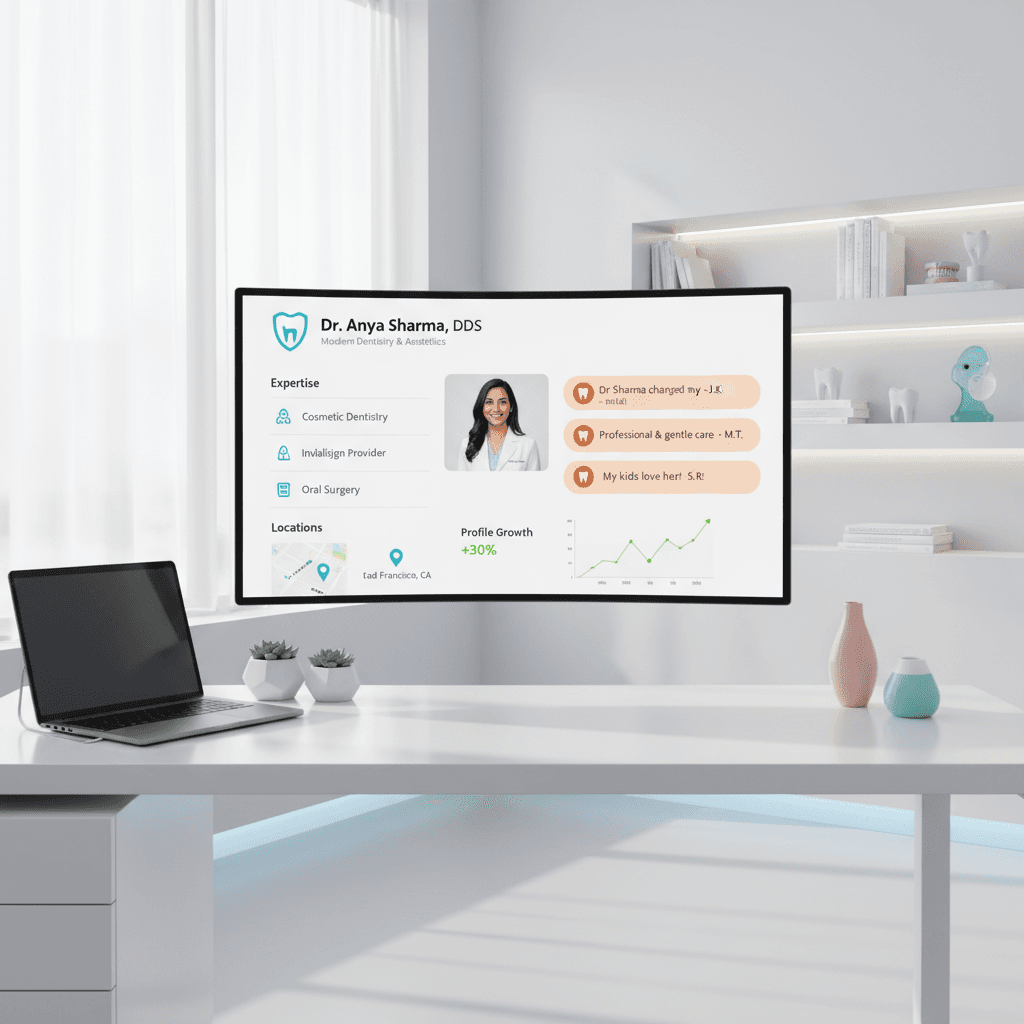
Transform your LinkedIn profile from a static CV into a conversion-focused landing page that passes the 3-second test. Local GPs, HR managers, and potential patients should immediately understand your expertise, location, and how you help them within three seconds of viewing your profile.
Focus on five key sections as conversion assets: Headline (your value proposition), About (trust-building story), Featured (case studies and videos), Experience (credibility markers), and Contact Info (clear next steps for referrals and consultations).
Crafting a Magnetic Headline & About Section (With Formulas)
Effective headlines follow proven formulas: “[Specialty] Dentist | [Location] | Helping [Target] Achieve [Outcome]” or “Principal Dentist at [Practice] | [Treatments] Specialist | [Geographic Area]”. For example: “Invisalign & Implant Specialist | Central London | Transforming Smiles for Busy Professionals”.
Structure your About section with five elements: opening authority statement, treatment specialisation, proof points (years of experience, cases completed), social proof (colleague testimonials), and clear referral or consultation invitation. Keep each element to one sentence for maximum impact.
Images, Banner, and Visual Consistency With Your Dental Website
Select profile images showing confident professionalism in clinical attire, while banner images highlight your practice environment or treatment outcomes (with proper consent). Maintain visual consistency with your dental website design, logo placement, and colour scheme to reinforce brand recognition across platforms.
5-Point Branding Alignment Checklist:
- Logo appears identically on website, Google Business Profile, and LinkedIn
- Colour scheme matches across all digital platforms
- Professional headshot consistent with website team photos
- Contact information mirrors website and Google listings
- Treatment messaging aligns with website service pages
Social Proof: Recommendations, Endorsements & Ethical Ask Scripts
Request LinkedIn recommendations from professional colleagues, specialists, lab partners, and lecturers—never patients due to GDC ethical considerations. Use simple scripts: “Hi [Name], I’m updating my LinkedIn profile to better serve referral partners. Would you mind writing a brief recommendation about our professional collaboration?”
Strategically seek endorsements for key skills: Invisalign, implantology, cosmetic dentistry, and patient care. This builds credibility and increases your profile’s visibility among both referrers and potential patients.
Wondering what AI tells patients about your practice? Free one page report in 48 hours. Where you are cited, where competitors win, and the gap.
Get your free AI Visibility CheckLinkedIn Content Strategy for Dentists: What to Post, How Often, and For Whom
Defining Your Core Audiences on LinkedIn
Successful linkedin dental marketing requires precise audience segmentation. Your content must speak to distinct groups with different motivations and decision-making processes.
Local professionals seeking Invisalign or implants respond to outcome-focused messaging: “Transform your smile in 6 months without metal braces.” Meanwhile, GP referrers need clinical credibility: “Advanced implant placement with 98% success rates and same-day temporisation.” Dental peers value thought leadership and continuing education content, while potential hires seek practice culture and career development opportunities.
Each audience segment requires different language and proof points. High-earning professionals want convenience and discretion. Referrers need clinical protocols and patient care standards. This segmentation prevents diluted messaging that fails to convert any group effectively.
Content Types That Work for Dental Practices (With Concrete Examples)
Educational posts generate consistent engagement: “3 signs you might benefit from Invisalign” or “Why dental implants beat dentures for professionals.” Post these twice weekly, focusing on high-value treatments your practice promotes.
Case-based stories build credibility when properly anonymised: “A busy London executive completed Invisalign treatment in 14 months, attending just 8 appointments.” Share one case story weekly, rotating between Invisalign, implants, and cosmetic treatments. Short 30-90 second videos explaining procedures work exceptionally well, requiring only smartphone recording with good lighting.
Recommended Posting Frequency: Personal profile: 3 posts/week. Company page: 1-2 posts/week. One educational article monthly for thought leadership positioning.
Posting Cadence and Best Times for UK Dental Practices
Consistency trumps frequency in LinkedIn dental marketing. Three quality posts weekly outperform daily low-value content. Test posting windows between 7:30-9:00 AM when professionals check LinkedIn before work, and 12:00-1:30 PM during lunch breaks.
Maintain this schedule for minimum 90 days before evaluating performance. LinkedIn’s algorithm favours accounts with consistent posting patterns, gradually increasing reach as engagement builds. Tuesday through Thursday typically generate highest engagement for professional services content.
Building a 30-Day LinkedIn Content Calendar for a Dental Clinic
Structure monthly content around treatment focus areas. Week 1: practice introduction and team expertise. Week 2: Invisalign education and case studies. Week 3: dental implant benefits and procedures. Week 4: referrer relationships and employer partnerships.
Specific post prompts include: “Why Invisalign works better for professionals than traditional braces,” “The real cost of missing teeth beyond aesthetics,” “How we support local businesses with employee dental health talks,” and “What to expect at your implant consultation.” This rotation ensures comprehensive coverage while maintaining treatment-specific momentum. For more inspiration, explore these dental blog post ideas that can be adapted for LinkedIn content.
Networking, Referrals, and Outreach: Turning Connections into Revenue
Building a Targeted Network in 15 Minutes a Day
Effective LinkedIn networking for dental practices requires strategic targeting. Use location filters within your catchment area plus job titles: “General Practitioner,” “HR Manager,” “Physiotherapist,” “Company Director.” Send 10-15 personalised connection requests daily, mentioning shared connections or local business interests.
Weekly routine: review new connections and tag them in your CRM as patients, referrers, partners, or peers. This systematic approach builds a qualified network of 200-300 relevant local professionals within six months, creating multiple referral pathways.
Outreach Scripts for Referral Partners & Local Employers
For GP introductions: “Hi Dr. [Name], I’m [Your name], principal dentist at [Practice] in [Location]. I noticed we’re both focused on comprehensive patient care in [Area]. I’d welcome the opportunity to support your patients requiring specialist dental treatment, particularly implants and orthodontics. Would you be interested in a brief coffee to discuss how we might collaborate?”
For local employers: “Hello [Name], I’m [Your name] from [Practice], specialising in discreet treatments like Invisalign for busy professionals. Many local companies offer employee dental benefits, and we’d be happy to provide lunch-and-learn sessions about oral health or special rates for your team. Might this interest [Company]?”
Follow up once after 5-7 days if no response, then quarterly with valuable content rather than direct asks. This builds relationships without appearing pushy.
Using LinkedIn Groups & Events to Grow Your Dental Brand
Join local business groups and dental professional groups where referrers and potential patients gather. Contribute valuable insights rather than promotional content. Share expertise on oral health connections to general health, particularly relevant for medical professionals. For further reading on the connection between oral health and systemic health, see this authoritative review on PubMed Central.
LinkedIn Events enable direct engagement with target audiences. Host “Invisalign for Busy Professionals” or “Dental Implants: What Every GP Should Know” webinars. Invite 50-100 local connections, follow up with attendees within 24-48 hours offering consultation or additional resources. This positions your practice as the local authority while generating qualified leads.
LinkedIn Ads for Dental Practices: When to Use Them and How to Target Correctly
When LinkedIn Ads Make Sense for a Local Dental Clinic
LinkedIn advertising becomes viable for dental practices targeting high-income professionals in metropolitan areas. City centre practices offering Invisalign and implants can justify LinkedIn’s higher cost-per-click when targeting executives, lawyers, and consultants willing to invest £3,000-£5,000 in private treatment. If you’re considering paid campaigns, a dental marketing plan can help you allocate budget and measure ROI effectively.
Associate and hygienist recruitment represents another strong use case. LinkedIn’s professional targeting capabilities excel at reaching qualified dental professionals seeking new opportunities. Test budgets of £500-£1,500 monthly for 6-8 weeks minimum to gather meaningful performance data.
Targeting Local Professionals and Referrers With Precision
Effective LinkedIn ad targeting combines location radius (5-15 miles from practice), job seniority (manager level and above), and company size (100+ employees for corporate dental schemes). Target job titles like “Director,” “Senior Manager,” “Partner,” and “Consultant” within your catchment area.
Campaign examples include free Invisalign suitability assessments for city professionals, or implant awareness webinars for local GPs. Ensure dedicated landing pages with tracking pixels, lead capture forms, and automated follow-up sequences before launching campaigns.
| Channel |
Lead Quality |
Cost Per Lead |
Best Use Case |
| LinkedIn Ads |
High-income professionals |
£50-£150 |
Invisalign, executive recruitment |
| Facebook/Instagram |
Mixed demographics |
£20-£60 |
Cosmetic treatments, awareness |
| Google Ads |
High intent searchers |
£30-£100 |
Emergency, implants, local SEO |
Common LinkedIn Referral Issues: Profile lacks local focus, inconsistent posting schedule, no direct outreach strategy, unclear referral process for GPs and specialists.
Analytics, ROI, and Integrating LinkedIn Into Your Wider Dental Marketing Strategy
What to Track: The Right LinkedIn KPIs for Dental Clinics
Track visibility metrics: profile views, post impressions, and search appearances. Engagement indicators include comment rates, content saves, shares, and connection acceptance rates above 60%. Pipeline metrics matter most: referral conversations initiated, consultation enquiries, and booking conversions.
Monthly targets for active practices: 200+ profile views, 50+ post engagements, 10+ meaningful conversations with potential referrers or patients. These leading indicators predict referral volume and case generation within 3-6 months.
Measuring LinkedIn ROI in Real-World Numbers
Calculate LinkedIn ROI using attributed cases monthly multiplied by average treatment values. Two Invisalign cases (£3,500 each) plus one implant case (£2,500) generates £9,500 monthly revenue. Against time investment of 15 hours (£1,500 opportunity cost) plus £500 ad spend, ROI reaches 375%.
Track attribution through UTM parameters, dedicated phone numbers, or direct patient surveys asking “How did you hear about us?” This data justifies continued linkedin dental marketing investment and guides budget allocation decisions. For more on how dental SEO and digital marketing can drive patient growth, see how dental SEO can lead to more patients.
Integrating LinkedIn With Dental SEO, Website & CRM
LinkedIn content should drive traffic to treatment-specific landing pages rather than homepage. Create dedicated Invisalign and implant pages with conversion tracking, matching LinkedIn messaging to on-page content for consistency.
Coordinate LinkedIn posting with dental SEO content calendars. LinkedIn articles can link to website blog posts, creating valuable backlinks while demonstrating expertise across platforms. Integrate lead sources into practice management software to track patient journeys from LinkedIn connection to treatment completion. For further reading on the importance of integrating digital strategies, refer to this research article on digital marketing in healthcare.
Team Training Essential: Train treatment coordinators and associates to engage with practice posts 2-3 times weekly, expanding organic reach through their professional networks.
Compliance, Ethics, and Reputation Management on LinkedIn for Dentists
GDC, Confidentiality & Privacy Considerations in the UK Context
UK dental practices must obtain written patient consent before sharing any case details or images on LinkedIn. Anonymise all case studies, removing identifying details while maintaining educational value. Avoid outcome guarantees or claims that could mislead patients about treatment success rates.
Key compliance rules: no identifiable patient information without explicit consent, balanced presentation of treatment options, clear fee structures when mentioned, and professional language throughout all communications.
Respond to negative feedback within 24 hours using this framework: acknowledge the concern, avoid clinical details, and move conversation offline. Example: “Thank you for your feedback. We take all concerns seriously and would welcome the opportunity to discuss this further with you directly. Please contact our practice manager so we can address your experience in detail.”
Frequently Asked Questions
How does LinkedIn dental marketing help UK dental practices attract high-value patients and build referral networks?
LinkedIn dental marketing enables UK practices to connect directly with affluent professionals and local healthcare providers who influence patient referrals. By strategically sharing valuable content and engaging with key decision-makers, practices build trust and visibility that translate into high-value patient bookings and steady referral streams.
What types of dental cases and patient demographics benefit most from LinkedIn marketing efforts?
LinkedIn marketing is most effective for attracting high-value cases such as Invisalign and dental implants, targeting affluent professionals and executives with disposable income. It also supports B2B referral relationships with GPs and specialists who refer patients seeking advanced cosmetic and restorative treatments.
What are the key strategies for creating a high-performing LinkedIn profile that attracts referrals and private patients?
A high-performing LinkedIn profile clearly communicates your expertise in high-value treatments, includes professional branding elements, and showcases patient success stories. Optimising your profile with relevant keywords and regularly posting targeted content helps attract both referral partners and private patients.
How long does it typically take for dental practices to see measurable results from consistent LinkedIn marketing activity?
Dental practices typically begin to see measurable results within 3 to 6 months of consistent LinkedIn activity, including regular posting, targeted outreach, and engagement. This timeframe allows for building meaningful connections and trust that convert into qualified consultations and treatment bookings.
About the Author
Dan Ashburn is the Co-Founder at Dominate Dental, the UK’s specialist agency for high-value patient acquisition.
Drawing on a decade of data-driven advertising experience and hundreds of clinic campaigns, Dan blends AI technology with human insight to deliver predictable streams of Invisalign, implant, and cosmetic dentistry consultations. His team’s results-focused approach has helped practices across London, Manchester, Birmingham, and nationwide convert marketing spend into chair-time—often booking 50+ qualified consultations per month while cutting no-shows.
When he’s not optimizing funnels or unpacking the latest algorithm updates, Dan shares actionable dental marketing ideas, real-world case studies, and ROI benchmarks so dental teams can make confident marketing decisions.
Real client results, not a promise. The number we commit to for your practice is agreed up front and written into the agreement.
