
Pediatric Dentistry Advertising 2026: The Ultimate UK Guide
On this page
What Makes Pediatric Dentistry Advertising Fundamentally DifferentWhy Parents, Not Children, Are Your True Marketing AudienceThe Trust and Safety Factor That Dominates Pediatric Dental DecisionsEmotional Versus Clinical Messaging in Pediatric AdvertisingThe Kid-Friendly Branding Imperative That Sets High-Converting Practices ApartBuilding Your Pediatric Dental SEO Foundation for Maximum Local VisibilityDominating Local Search for High-Intent Pediatric KeywordsGoogle Business Profile Optimization Specifically for Pediatric PracticesCreating Location-Specific Service Pages That Convert Parent SearchesLocal Schema Markup That Helps AI-Driven Search Recognize Your Pediatric AuthorityBuilding High-Quality Local Backlinks Specifically from Pediatric-Adjacent WebsitesContent Marketing That Builds Parent Trust and Establishes Practice AuthorityEducational Content Themes That Address Parents’ Actual AnxietiesCreating Pillar-and-Cluster Content Architecture for Pediatric Dentistry TopicsVideo Content That Reduces Dental Anxiety Before First VisitsSeasonal Content Calendar for Pediatric Dental MarketingUsing AI Tools to Identify Content Gaps Your Competitors Haven’t AddressedSocial Media Strategies That Drive Engagement and Appointment BookingsInstagram as Your Primary Parent Engagement PlatformTikTok for Reaching Gen Z Parents and Building Viral ReachFacebook for Targeted Local Paid Advertising and Community BuildingPaid Advertising Strategy That Targets High-Intent Parent SearchesGoogle Ads for “Ready-to-Book” Parent SearchesFrequently Asked QuestionsWhy is emotional safety more important than clinical credentials in pediatric dentistry advertising?How can pediatric dental practices effectively use local SEO and schema markup to attract more parents?What specific messaging strategies resonate best with parents when marketing pediatric dental services?How can pediatric dental offices visually communicate trust and comfort to parents through their advertising?About the AuthorBefore you read on. Want to know which dentist AI recommends in your town, and whether it is you?
Get your free AI Visibility CheckKey Takeaways
- Pediatric dentistry advertising targets emotional safety and anxiety management rather than clinical credentials.
- Parents prioritize their child’s comfort over technical expertise when choosing dental care.
- Effective marketing for pediatric dentistry requires rethinking messaging, visual branding, and conversion strategies.
- Understanding the psychological triggers unique to parents is essential for successful pediatric dental advertising.
Table of Contents
- What Makes Pediatric Dentistry Advertising Fundamentally Different
- Building Your Pediatric Dental SEO Foundation for Maximum Local Visibility
- Local Schema Markup That Helps AI-Driven Search Recognize Your Pediatric Authority
- Content Marketing That Builds Parent Trust and Establishes Practice Authority
- Social Media Strategies That Drive Engagement and Appointment Bookings
- Paid Advertising Strategy That Targets High-Intent Parent Searches
What Makes Pediatric Dentistry Advertising Fundamentally Different
Pediatric dentistry advertising operates on entirely different psychological triggers than general dental marketing. While adult patients evaluate clinical credentials and treatment outcomes, parents prioritize emotional safety, anxiety management, and their child’s comfort above technical expertise. This fundamental shift requires a complete rethinking of your messaging, visual branding, and conversion strategy.
Why Parents, Not Children, Are Your True Marketing Audience
Parents control 100% of purchasing decisions for pediatric dental care, yet most practices mistakenly target children with bright colors and cartoon characters. Your real audience consists of anxious parents researching “pediatric dentist near me” at 11 PM, worried about their child’s upcoming appointment.
Parent decision-making criteria differs entirely from adult patients. Where adults prioritize convenience and clinical outcomes, parents evaluate practices based on emotional reassurance, transparent communication about procedures, and evidence that staff genuinely enjoy working with children. Your pediatric dentistry advertising must address these specific pain points: fear of their child experiencing dental trauma, concerns about cost transparency, and time constraints around school schedules.
For a comprehensive approach to building your brand and attracting more families, explore this dental marketing plan designed specifically for dental practices.
The Trust and Safety Factor That Dominates Pediatric Dental Decisions
Parents evaluate practices based on emotional safety signals before considering clinical expertise. Three core trust drivers influence their booking decisions: demonstrated staff gentleness through patient testimonials, transparent communication about what happens during appointments, and child-centric environment design visible in photos and videos.
Your advertising must communicate these elements both visually and verbally. Instead of showcasing advanced equipment, feature images of staff members kneeling at child height during consultations. Rather than listing credentials, include parent testimonials specifically mentioning how staff made their anxious child feel comfortable.
Emotional Versus Clinical Messaging in Pediatric Advertising
General dental advertising emphasizes clinical outcomes and technical procedures. Pediatric dentistry advertising must emphasize experience quality and emotional outcomes. Messaging like “cavity-free checkups” underperforms compared to “made my child feel comfortable and excited about dental health.”
Key Insight: Practices using emotion-focused messaging (“We help children feel safe and happy”) see 40% higher parent inquiry-to-booking conversion rates than those using clinical messaging (“Advanced pediatric dental procedures”).
Balance educational content about proper brushing techniques with reassurance content about first visit preparation. Parents need both information and emotional comfort to move forward with booking.
The Kid-Friendly Branding Imperative That Sets High-Converting Practices Apart
Kid-friendly branding encompasses visual, verbal, and environmental elements that signal safety to both children and parents. This goes beyond cartoon mascots to include office color schemes that feel welcoming rather than clinical, team appearance that suggests warmth and patience, communication style that acknowledges parent concerns, and appointment flexibility that accommodates school schedules.
Specific branding elements that directly influence parent conversion include warm lighting in office photos, staff members shown interacting naturally with children, clear explanation of what happens during different procedures, and prominent display of anxiety management techniques. These elements must be consistently reflected across your website, social media, and advertising materials.
Building Your Pediatric Dental SEO Foundation for Maximum Local Visibility
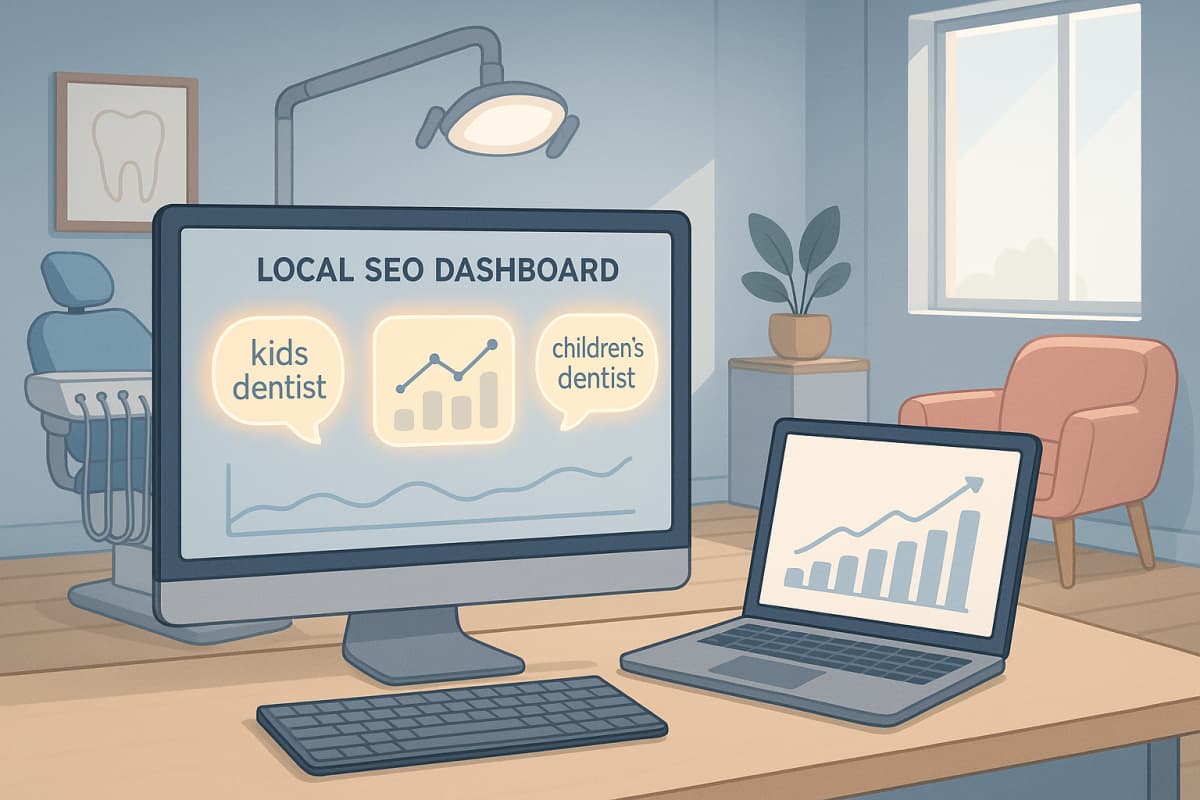
Local SEO forms the backbone of successful pediatric dentistry advertising, with parents conducting 85% of their initial research through location-specific searches. Unlike general dental practices, pediatric practices must optimize for anxiety-related keywords and parent-focused search intent to capture high-converting traffic.
To improve your local rankings and attract more families, consider implementing local SEO for dentists strategies tailored to pediatric practices.
Dominating Local Search for High-Intent Pediatric Keywords
“Pediatric dentist near me” and “children’s dentist in [city]” represent your highest-value keywords, with parents using these phrases when ready to book appointments. Practices ranking in the top 3 Google positions generate 300% more new patient enquiries compared to those on page two.
Target specific keyword clusters that reflect parent search behavior: “emergency pediatric dentistry” for urgent situations, “NHS pediatric dentistry” for budget-conscious families, “Invisalign for teens” for orthodontic services, and “special needs dentistry” for specialized care. Each cluster requires dedicated landing pages addressing specific parent concerns and search intent.
Google Business Profile Optimization Specifically for Pediatric Practices
Six critical profile elements increase parent click-through rates: accurate NAP consistency across all online directories, clear age ranges served (infants through teens), specific treatment specialties prominently displayed, functional appointment booking button, kid-friendly imagery showing happy children and welcoming staff, and rapid response to parent inquiries.
Traditional dental profiles underperform for pediatric practices because they fail to signal “child-safe” environment in their structure. Parents scan profiles for emotional safety cues, not just clinical information. Your profile description should emphasize anxiety management, gentle approach, and positive experience rather than technical procedures.
Creating Location-Specific Service Pages That Convert Parent Searches
Structure each service page with this conversion-focused format: parent problem statement addressing common concerns, clear solution explanation in non-technical language, child experience assurance describing what the appointment feels like, and prominent call-to-action to book consultation.
Create these essential pages immediately: “First Dental Visit Preparation” targeting anxious parents, “Pediatric Tooth Extractions” addressing emergency situations, “Fluoride Treatments for Children” for preventive care, and “Managing Dental Anxiety in Children” for worried families. Each page should target 1-1.5% keyword density naturally, include internal links to your homepage, and implement FAQ schema markup.
Wondering what AI tells patients about your practice? Free one page report in 48 hours. Where you are cited, where competitors win, and the gap.
Get your free AI Visibility CheckLocal Schema Markup That Helps AI-Driven Search Recognize Your Pediatric Authority
Standard dentistry schema markup fails pediatric practices because it doesn’t communicate age-specific services, anxiety management capabilities, or child-focused treatment approaches that AI search algorithms need to properly categorize your practice. When parents search for “pediatric dentist near me,” AI-driven results prioritize practices with clear, structured data indicating specialized pediatric care.
Implement pediatric-specific structured data by adding “pediatricdentist” designation to your LocalBusiness schema, include age ranges served (typically “ages 1-18”), and describe treatment procedures with child-focused language. For example, instead of generic “dental examination,” use “gentle pediatric dental examination with anxiety management.” This specificity helps AI understand your practice’s unique positioning.
Use Google’s Rich Results Test to verify your schema renders correctly in search results. Many practices lose visibility in AI overviews simply because their structured data doesn’t clearly communicate pediatric specialization to search algorithms.
Building High-Quality Local Backlinks Specifically from Pediatric-Adjacent Websites
Target link sources that naturally connect to pediatric dental services: local pediatrician directories, school district websites, parenting blogs in your region, and NHS partnership directories. These contextually relevant links carry significantly more authority than generic business directories because they signal topical relevance to search engines.
Create shareable pediatric oral health assets that naturally attract links from these sources. Develop downloadable parent guides like “First Dental Visit Preparation Checklist” or infographics showing proper brushing techniques for different age groups. Local pediatrician offices often link to these resources, providing high-quality backlinks that improve your local search authority.
For more actionable ideas, check out these dental marketing ideas that can help you build authority and attract local backlinks.
Content Marketing That Builds Parent Trust and Establishes Practice Authority
Educational content for pediatric dentistry advertising must address parents’ emotional anxieties alongside clinical information. The highest-performing content themes directly answer parent search intents: “Is my child’s dental anxiety normal?” requires reassurance and normalization, while “How do I prepare my child for their first dental visit?” demands step-by-step guidance with emotional support.
Educational Content Themes That Address Parents’ Actual Anxieties
Focus on five core parent search intents that drive appointment bookings: dental anxiety normalization, first visit preparation, cavity prevention education, orthodontic timing guidance, and emergency dental care. Generic dental health content underperforms because it ignores the emotional component parents prioritize when selecting pediatric providers.
Diversify content formats to match different parent learning preferences: comprehensive blog posts (1,200-1,500 words) for detailed research, downloadable guides for quick reference, 90-120 second video explainers for visual learners, and Q&A articles addressing specific concerns like “What happens if my child won’t open their mouth during the exam?”
To ensure your content strategy covers all the right topics, review these dental blog post ideas for inspiration.
Creating Pillar-and-Cluster Content Architecture for Pediatric Dentistry Topics
Build topical authority with a pillar page titled “Pediatric Dental Health: Complete Parent’s Guide” (2,500+ words) supported by cluster pages covering specific topics: “Signs Your Child Needs a Dental Visit,” “Pediatric Fillings vs. Sealants,” “Fluoride Safety for Children,” and “Thumb-Sucking and Dental Development.” This structure improves AI-driven search visibility by demonstrating comprehensive expertise.
Link each cluster page back to your pillar page while ensuring the pillar page includes navigation to all clusters. This internal linking strategy signals topical authority to search engines and creates multiple entry points for parents across different stages of their search journey.
Video Content That Reduces Dental Anxiety Before First Visits
Produce four essential video types: 90-second office tours showing child-friendly environments, 3-5 minute procedure explainers demonstrating exactly what happens during examinations, team introduction videos humanizing staff members, and parent testimonials providing social proof. Film in warm lighting with gentle background music, featuring staff interacting positively with children (with proper parental consent and HIPAA compliance).
Distribute strategically by embedding videos on relevant service pages to improve engagement signals, uploading to YouTube for multi-platform presence, and repurposing as 60-second clips for social media. Video content consistently outperforms text-only pages for parent engagement and appointment conversion rates.
For more on leveraging video, see these tips on dental video marketing to boost parent engagement and trust.
| Content Type | Primary Purpose | Optimal Length | Parent Intent Served |
|---|---|---|---|
| Office Tour Video | Environment familiarization | 90 seconds | Anxiety reduction |
| Procedure Explainer | Process transparency | 3-5 minutes | Education/preparation |
| Parent Testimonial | Social proof | 60-90 seconds | Trust building |
| Team Introduction | Staff humanization | 2-3 minutes | Relationship building |
Seasonal Content Calendar for Pediatric Dental Marketing
January-February focuses on “New Year, Healthier Smiles” with preventive care messaging, while August preparation targets back-to-school dental checkups. April content centers on “Healthy Snacking for Children” with seasonal nutrition tie-ins, and June-July emphasizes summer break dental safety tips.
October content addresses Halloween candy management strategies, while November-December features gift guides for dental-healthy toys and holiday treat alternatives. This seasonal approach leverages predictable parent search behavior and creates natural keyword clustering opportunities throughout the year.
Using AI Tools to Identify Content Gaps Your Competitors Haven’t Addressed
Apply generative AI for keyword clustering and topic gap identification by analyzing competitor content against parent search query data. Identify overlooked parent questions like “How to help anxious child during dental anesthesia” or “What if my child has a panic attack at the dentist?” that competitors aren’t addressing comprehensively.
Process involves analyzing competitor content libraries, cross-referencing with parent search data, and prioritizing 5-10 high-intent questions with low competitive content density. This approach creates immediate content opportunities that capture parent searches without direct competition.
Social Media Strategies That Drive Engagement and Appointment Bookings
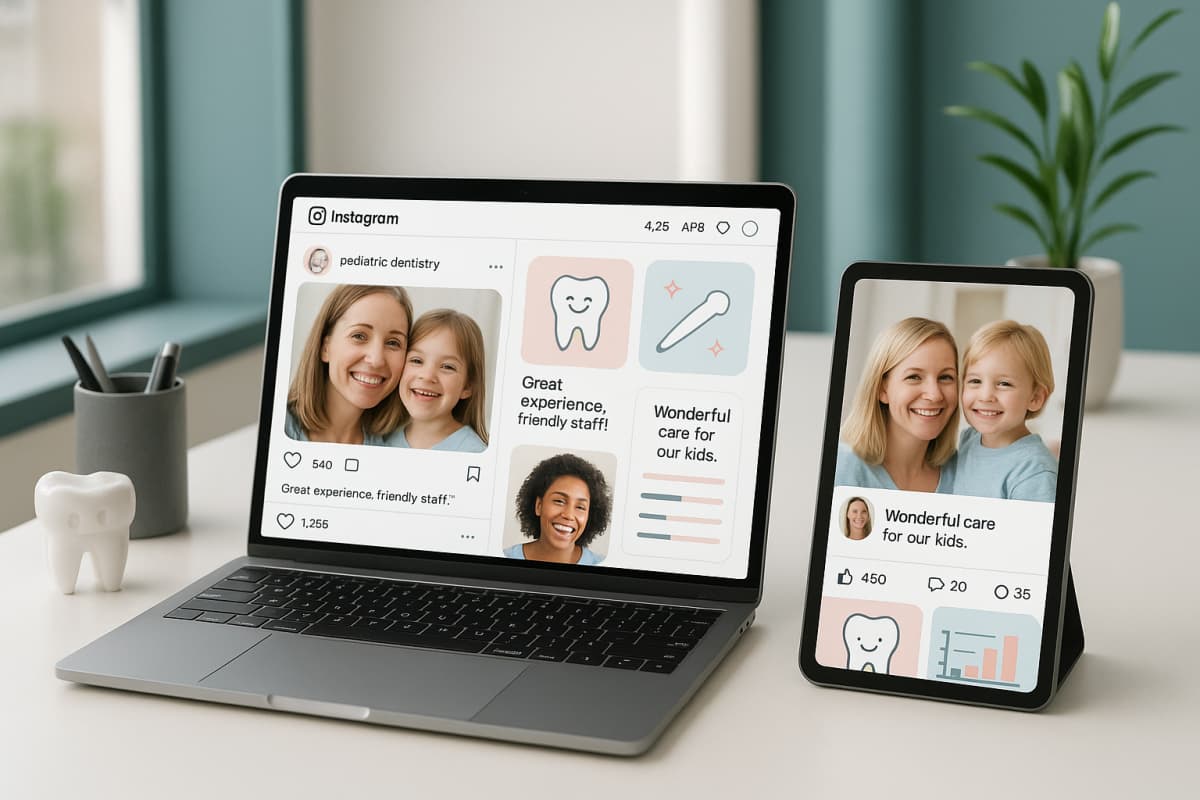
Social media for pediatric dentistry advertising must prioritize parent engagement over clinical showcasing. Instagram dominates as the primary platform for reaching parents aged 25-45, while TikTok captures younger millennial and Gen Z parents seeking authentic, educational content about children’s dental care.
For more inspiration on building your presence, explore these social media for dentists strategies that drive real engagement.
Instagram as Your Primary Parent Engagement Platform
Instagram’s visual format perfectly showcases kid-friendly environments while reaching parents during peak engagement windows. Rotate five content pillars weekly: behind-the-scenes office culture, parent testimonials with HIPAA compliance, educational carousel posts, patient success stories, and team expertise highlighting.
Post 3-4 times weekly during optimal windows (7-9 AM and 4-6 PM when parents check phones during commutes). Target 3-5% engagement rates and 15-20% quarterly follower growth—significantly higher than general dental practices due to emotional content resonance.
TikTok for Reaching Gen Z Parents and Building Viral Reach
TikTok’s algorithm rewards educational, entertaining short-form content that builds brand awareness rather than direct conversions. Create “myths vs. facts” videos about pediatric dentistry (60-90 seconds), quick hygiene tips, behind-the-scenes team personalities, and day-in-the-life practice content.
Combine trending hashtags (#dentisttiktok, #parenttips) with hyper-local tags (#YourCityNamedentist, #YourCityNameparenting). TikTok builds authority and drives parents to Google search for appointment booking rather than generating direct platform conversions.
Facebook for Targeted Local Paid Advertising and Community Building
Maintain organic presence with 2-3 weekly posts featuring community involvement and educational content, responding to comments within 4 hours. Launch paid campaigns targeting parents aged 25-50 within 5-10 mile radius using custom audiences from existing patients and website visitors.
Allocate £200-500 monthly across three campaign types: “Schedule Your Child’s Checkup” for appointment conversion, “Learn About Our Practice” for awareness building, and “Special Offers” for seasonal promotions. Scale budget based on conversion tracking performance.
To maximize your Facebook results, see these proven dental Facebook marketing tactics for dental practices.
| Platform | Content Focus | Posting Frequency | Expected Engagement | Monthly Budget |
|---|---|---|---|---|
| Visual storytelling, testimonials | 3-4 posts/week | 3-5% engagement rate | £150-300 (paid promotion) | |
| TikTok | Educational, behind-scenes | 2-3 videos/week | 5-8% engagement rate | £100-200 (organic focus) |
| Community, paid advertising | 2-3 posts/week | 2-4% engagement rate | £200-500 (paid ads) |
Paid Advertising Strategy That Targets High-Intent Parent Searches
Effective pediatric dentistry advertising through paid channels requires targeting parents at the moment of booking intent. Google Ads captures “ready-to-book” searches, while Meta platforms excel at awareness building and lead generation through emotional storytelling that resonates with parent concerns.
For expert help with your paid campaigns, consider partnering with a dental marketing agency that specializes in pediatric and family dental practices.
Google Ads for “Ready-to-Book” Parent Searches
Target high-intent keywords: “pediatric dentist [city] appointments,” “emergency children’s dentist,” “Invisalign for teens near me,” and “special needs dentist [region].” Structure ad copy with comfort-focused headlines (“Gentle Pediatric Dentistry for Children,” “Book Your Child’s Visit Today”) and clear calls to action. Use ad extensions to highlight anxiety management, flexible scheduling, and parent testimonials. Track conversions rigorously to optimize for cost per qualified lead and maximize ROI.
For a deeper dive into optimizing your paid search, you may find this guide on Google Ads for dentists helpful.
For additional insights on dental SEO and how it can help you attract more patients, read this article: how dental SEO can lead to more patients.
Frequently Asked Questions
Why is emotional safety more important than clinical credentials in pediatric dentistry advertising?
Emotional safety is paramount because parents prioritize their child’s comfort and anxiety management over technical expertise when choosing a pediatric dentist. Unlike adult patients, parents seek reassurance that their child will feel safe and cared for, making trust and emotional connection the key drivers in their decision-making process.
How can pediatric dental practices effectively use local SEO and schema markup to attract more parents?
Pediatric dental practices can leverage local SEO by optimizing for location-specific keywords like “pediatric dentist near me” and implementing pediatric-specific schema markup to help AI-driven search engines recognize their authority in children’s dental care. This enhances local visibility, making it easier for anxious parents to find and trust the practice online.
What specific messaging strategies resonate best with parents when marketing pediatric dental services?
Messaging that emphasizes emotional reassurance, transparent communication about procedures, and evidence of staff’s genuine care for children resonates best. Addressing parental concerns such as fear of dental trauma, cost transparency, and accommodating school schedules directly builds trust and encourages appointment bookings.
How can pediatric dental offices visually communicate trust and comfort to parents through their advertising?
Visual branding should focus on warm, calming colors and imagery that reflect a gentle, child-friendly environment without relying solely on cartoon characters. Showcasing real staff interactions, patient testimonials, and clean, welcoming spaces helps convey professionalism and emotional safety to parents.
Real client results, not a promise. The number we commit to for your practice is agreed up front and written into the agreement.
Patients in the chair, not just leads. Guaranteed.
We own the whole journey to the attended consultation. New attended patient consultations in 90 days, or we work free until you hit them.Book a chat with Josie